






Obama to Jewish Audience: Iran Deal Leaves Future President Better Positioned to Address Nuclear Threat
Error: Contact form not found.

 by Eliezer Sherman

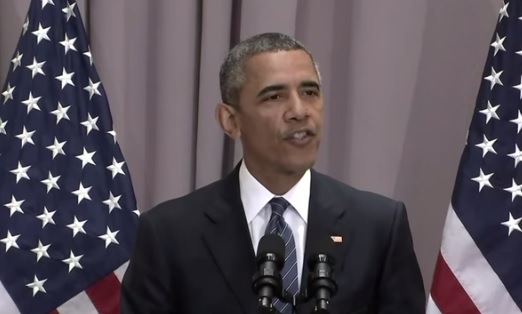
President Obama defends the Iran nuclear deal. Photo: Screenshot.
Fifteen years from now, the president, whoever that may be, will be in a stronger position to respond to the threat of Iranian nuclear weapons, if the current deal with Tehran is adopted and implemented, President Barack Obama told an online audience for the Jewish Federations of North America on Friday.
Obama said the U.S. would have greater “knowledge” of the Iranian nuclear program after 15 years, when key provisions of the agreement such as limits on uranium enrichment and centrifuges expire.
The president vowed that the U.S. would be prepared to respond in the even that Iran dashes for nuclear weapons. “We are confident in our ability to respond,” he said.
Although the president insisted that international will to continue to enforce multilateral sanctions against Iran’s financial and oil sectors would largely dissolve if Congress moves to reject the deal, he also said the U.S. would not need agreements from China, Russia, or even the U.S.’s European partners if Iran violates the deal to re-impose multilateral sanctions. And he said the U.S. was not backing away from sanctions on Iranian human rights abuses and support for terror.
Additionally, the president noted that the interim agreement announced in late 2013, in which Iran scaled back some of its enrichment activities, paved the way for the current deal, setting a precedent for removing some sanctions in exchange for Iranian compliance on scaling back its nuclear program.
The president addressed Israeli opposition to the deal, calling it a “visceral reaction” to Iran’s denial of the Holocaust and perennial pledges to decimate the Jewish state. He insisted that the “best security is to enter into negotiations with your enemies.”
Obama conceded that while Iran has yet to rein in its harsh rhetoric against the U.S. — such comity is “not forthcoming at the moment,” he admitted — his conclusion was that that’s how “politicians operate … even in Iran.”
The president played down the perceived animosity between himself and Israeli Prime Minister Benjamin Netanyahu, noting that “my best friends are the ones who I can be honest with. That’s what being good friends means.”
He rejected notions that there should be no daylight between the White House and Jerusalem — a notion perpetuated most recently by former Israeli ambassador to the U.S., Michael Oren — saying that “could be dangerous if it leads us to make bad decisions for the interests of these two countries.”
Still, he said, on the Iranian issue “we agree more than we disagree,” adding that in the debate over the Iran deal, “we’re all pro-Israel, and we’re all family.”
He said relations between the U.S. and Israel would improve “quickly” if the deal is implemented, and encouraged working together to “enhance our security cooperation; to think about the next generations of missile defense programs, how we improve our intelligence and interdiction to prevent arms from reaching terrorist groups,” and to overall counteract Iranian-backed terrorist activities in the region.


