






Mideast Analyst: Israel Wants US to Take More Active Role in Region
Error: Contact form not found.

 by Algemeiner Staff

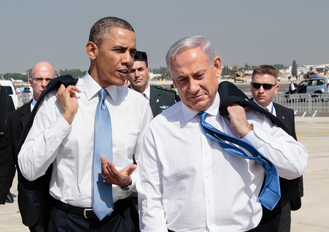
President Barack Obama and Prime Minister Benjamin Netanyahu in Israel on March 20, 2013. Photo: Pete Souza/White House.
Israelis would like to see the US take on a more assertive role in the Middle East to enhance their security, Michael Herzog, the Israel-based Milton Fine International Fellow of the Washington Institute think tank, told Politico on Wednesday.
“There is a feeling that the US role has weakened over … time,” said Herzog, a retired IDF brigadier general, ahead of Prime Minister Netanyahu’s upcoming Washington meeting with President Obama on November 9th.
Additionally, Herzog said, Israelis want their prime minister to raise the issues of the situation in Syria, including Iran’s growing military presence; Hezbollah’s building up of the southern Syrian front near Israel; Hamas’ rearming itself; and terrorist groups cropping up within Israel’s borders.
He also said Israelis hope for robust enforcement of the Joint Comprehensive Plan of Action, the nuclear deal with Iran championed by President Obama and rejected by most of the Knesset.
About Syria, Herzog said: “Israel does not want to get involved in that war.”
“But there are several big concerns for Israel. First is, of course, cross-border attacks; secondly is shipment of strategic weapons from Syria to Hezbollah in Lebanon; and thirdly, the Iranian, I would say, ambition to establish an active front against Israel with Hezbollah in southern Syria,” he said.
In Netanyahu’s meeting with President Barack Obama in Washington he is expected to discuss the Iran deal and other Israeli security concerns, as well as a 10-year Memorandum of Understanding for US military assistance to Israel.
The current memorandum, signed under the Bush administration and set to expire in 2018, amounted to $30 billion in US assistance, with Israel currently receiving $3.1 billion each year. According to Bloomberg, Israel could be seeking to boost that to $4.5 billion per year, responding to the threat from Iran, among other concerns.
Herzog, whose brother, Isaac Herzog, currently heads the Israeli Labor Party and opposition, expressed pessimism about reaching a deal with the Palestinians: “The prospects for resumed negotiations are low and I think almost everybody realizes that even if you get the parties to sit down to the table and negotiate, this will not be resolved.”


