










How Would Israeli Human Rights Groups Have Reacted During World War II?
Error: Contact form not found.

 by Gidon Ben-Zvi

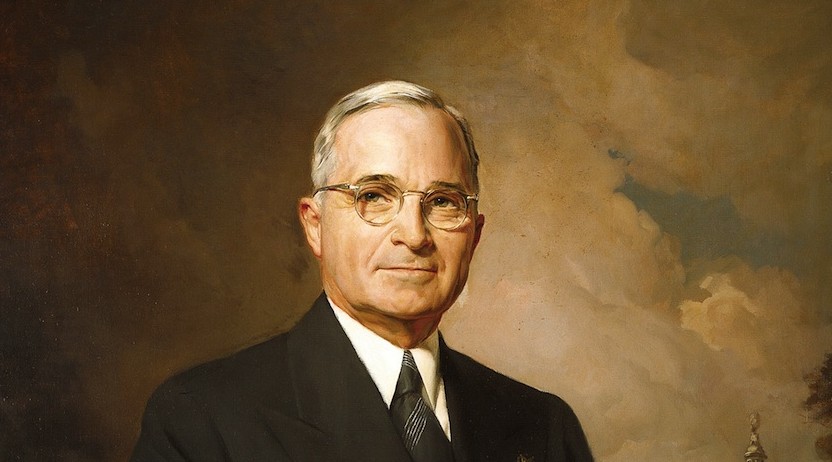
A portrait Harry S. Truman. Photo: Greta Kempton.
Since the outbreak of the recent terror attacks against Israeli citizens, human rights groups such as B’Tselem have been rushing to defend Palestinians who are allegedly being subjected to collective punishment by the Israeli military.
In its latest report, filed from occupied Hebron, B’Tselem dedicates the vast majority of its time and space to testimonials of men and women who are positively chaffing under the “sweeping restrictions imposed by the security forces on the movement of Palestinians in Hebron…”
According to the prominent group of academics and attorneys that comprise B’Tselem, “This policy of separation…constitutes collective punishment of residents unfortunate enough to live or work in areas close to where settlers have chosen to live. As such, these restrictions are immoral and unlawful.”
Human rights groups around the world kick up a storm whenever elderly Palestinian women and schoolchildren are inconvenienced by a checkpoint in Hebron. Yet they rarely speak up when elderly Israelis and Israeli children are murdered. A checkpoint is not collective punishment; it’s a justified security measure.
As B’Tselem continues to document and educate the public about Israel’s human rights violations, one can only imagine how much more good this august group could do on behalf of repressed peoples around the world if it weren’t singularly focused on Israel’s presence in the West Bank.
If only B’Tselem could dedicate a bit more time, effort, and treasure to eradicating collective punishment outside of colonized Palestine, Tibet would be free. Ukraine would be reunited. Morocco would return Western Sahara. Spain would allow the Basque separatists to, well, separate.
It’s a crying shame that B’Tselem and other like-minded groups weren’t around during World War II to document and draw attention to some of the most outrageous examples of collective punishment.
While the controversial fire-bombing of Dresden killed an estimated 25,000 civilians during World War II, the Allies’ act of “collective punishment” also succeeded in keeping more than a million Germans out of the German army; from manning anti-aircraft defenses; from making ammunition and from making urgent repairs. In addition, Dresden housed factories that were producing weapons and equipment for the Nazi war effort. Germany was forced to surrender three months after the Dresden bombing.
Another joint United States-United Kingdom “collective punishment” effort was the bombing of Hiroshima and Nagasaki. While the war in Europe had already concluded, the Allies prepared for what was anticipated to be a very costly invasion of the Japanese mainland. The Japanese had repeatedly refused to accept the Allies’ demands for unconditional surrender, even if it meant facing “prompt and utter destruction.” While the issue continues to generate scholarly debate, President Harry Truman estimated that the bombings saved up to half a million US lives. Many agree with that assessment.
With the help of B’Tselem and other human rights advocates, what a wonderful world it could have been. France would be speaking German and Korea would be a Japanese province.


