





The New York Times Description of a Palestinian Terrorist — Then and Now
Error: Contact form not found.

 by Ira Stoll

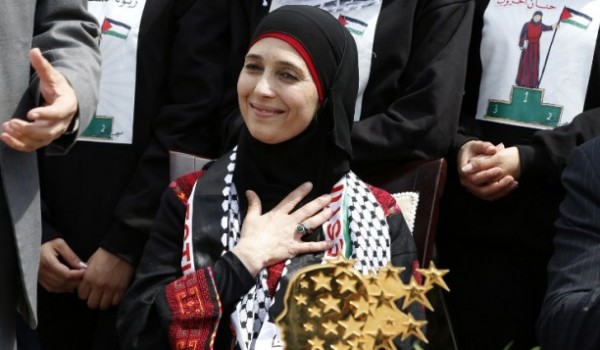
Global Teacher Prize Winner Hanan Al Hroub. Photo: globalteacherprize.org.
An award-winning second-grade teacher in the West Bank is the subject of a profile in the New York Times that is noteworthy for how it handles the topic of the educator’s husband.
The article states, “Some Israelis have denounced [Hanan Al Hroub] as part of a Palestinian education system they see as inciting violence, and noted with dismay that her husband assisted in the killing of six Jewish settlers in the West Bank city of Hebron in 1980.”
Later, it explains:
Ms. Hroub’s husband — now a legal adviser to the Palestinian Authority — was involved in the 1980 ambush of a group of Israelis trying to revive a Jewish settlement in Hebron. (Some Palestinian news sites have praised him as the “mastermind” of the attack, though a New York Times article at the time described him as having assisted.)
Clicking through the link to David K. Shipler’s Times dispatch from 1980 is a pretty good way to measure how much the paper’s coverage has changed for the worse over 36 years. Shipler’s story describes the Arabs forthrightly as a “terrorist squad,” employing a term that the Times now avoids in connection with attacks against Jews in the West Bank.
The dispatch also refers to the Jews who were murdered, at least on first reference, not as “settlers” but as “Jewish worshipers.” It notes that three of the slain Jews were “yeshiva students aged 20 and 21,” and that a fourth was American born (a Vietnam veteran, even).
Even the current Times description of what the victims of the terrorist attack in Hebron were there to do — “revive a Jewish settlement in Hebron” — subtly links the victims to an enterprise — “settlements” — that the Times is constantly telling readers is widely considered illegal and an obstacle to peace. Again, the 1980 Times dispatch does at least a bit better, explaining that Hebron is “holy” to Judaism as “the burial place of Abraham,” and that the “Jewish presence” there “was uprooted by Arab rioting in 1929 and 1936.” “Jewish presence” — the term used in the 1980 piece — is a much more neutral and less loaded term than “settlement,” the word used in the current Times article.
The 1980 article reported that the attack took place on Friday evening as the Jews returned from Sabbath prayers at the Tomb of the Patriarchs and walked to “the old Hadassah clinic, a Jewish-owned building abandoned after the riots.”
As Richard Behar points out in a post at The Mideast Dig, the author of the current Times dispatch, Diaa Hadid, has a prior history as an anti-Israel publicist and activist. But I care less about her past history and more about what she is up to these days, which, at least in this case, is a subtle but unmistakable erosion in quality of today’s Times coverage when measured against the standard of decades ago.
One might argue that the 1980 article was an in-depth examination of the terrorist attack, while today’s piece is mainly about the teacher and only touches on the attack in passing. One might also argue that by including a hyperlink to the former, the latter allows current Times readers to see for themselves what happened. But that only applies to online readers. Readers of the print edition are stuck with the loaded language — and what the Times in 1980 accurately described as a “terrorist” attack on “worshipers” is laundered by the Times of today into a mere “ambush” of “settlers.”