







The Middle East Quartet: An Institutionalized Failure
Error: Contact form not found.

 by Daniel Mandel

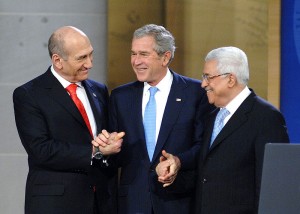
Former Israeli Prime Minister Ehud Olmert(left) with former President George W. Bush, and Palestinian President Mahmoud Abbas shake hands following President Bush's address at the Naval Academy's Memorial Hall in 2008.
Strange as it might seem, U.S. policy defers to others — sometimes, more than is good for it. Thus, for some time, there has been not been much of a U.S. policy towards Israel and the Palestinians. There has been a Middle East Quartet policy. And it has taken the U.S. into an expensive dead-end.
The Quartet is a decade-old, hastily conceived grouping of the European Union, the Russian Federation, the United Nations, and the United States. It includes entrenched pro-Arab bureaucracies. Unsurprisingly, it has adopted policies that prolong rather than mitigate the Palestinian/Arab war on Israel — while America funds both the Israelis and the PA.
The Quartet, in its latest communiqué, insists on a resumption of Israeli-Palestinian peace negotiations encompassing a Palestinian state alongside Israel, to be concluded “no later” than the end of 2012. No matter that, in 2000 and again in 2009, the Fatah-controlled Palestinian Authority (PA) refused to accept peace plans delineating just such an outcome.
The Quartet demands $1.1 billion in international funding of the PA for 2012, active social and economic development programs in certain PA sectors, and so on. But it is less insistent about what is to be done about continuing Palestinian terrorism and incitement to violence.
Thus, the Quartet “calls” for Palestinians to “improve law and order … fight violent extremism, and … end incitement”; it “considers” matters to be “fragile and unsustainable” with the West Bank and Gaza remaining divided between rival Palestinian groups; it condemns “rocket attacks from Gaza”; it “stresses … the need for calm and security for both peoples.” But negotiations are not conditional on any of these changing.
Thus, the Quartet simply institutionalizes the state of war it is ostensibly designed to end.
So the “peace process” continues. With its lack of consummation comes Arab displeasure and international pressure on Israel to break the logjam. The U.S., as Israel’s principal ally, also incurs wrath. That suits Arab powers and American rivals — but the U.S. continues to lend its name to the Quartet. Under Barack Obama, it even has a president who sees it as a priority to relieve pressure on the PA.
Thus, U.S. funding for the PA is now virtually sacrosanct. The other week, Secretary of State Hillary Clinton overrode Congress when House Foreign Affairs Committee Chairwoman Ileana Ros-Lehtinen (R-FL) put a hold on $147 million in U.S. funding to the PA. Ros-Lehtinen sought to pressure the PA into dropping its bid for statehood via the United Nations and refusing negotiations without preconditions. The Obama administration wants negotiations — but it won’t penalize the PA when it evades them. All carrots and no sticks.
Similarly, the U.S. goes along with Quartet policy to ignore PA incitement and the routine honoring of terrorists, like Dalal Mughrabi. To cite a typical example, when Fatah terrorists murdered an Israeli in January 2010, the PA condemned Israel for hunting down and killing the perpetrators. PA president Mahmoud Abbas also sent condolences to the families of the three terrorists. His prime minister, Salam Fayyad, personally visited the terrorists’ families. But the Obama Administration said nothing, even when specifically informed of these events by the Israeli government.
Yet, three months later, the Obama administration said that it “will continue [!] to hold Palestinian leaders accountable for incitement.” It could at least be more honest, like the British Foreign Office, which admitted last week that it never even raises these matters with the PA.
Only weeks ago, a PA minister, Majida Al-Masri, called for Fatah and Hamas to unite in order “to turn to the struggle for the liberation of Palestine — all of Palestine.” The Quartet — and the U.S. — said nothing and did less.
Quartet policy, like so many multilateral ventures, is politics of the lowest common denominator. It ignores unpleasant realities (no Palestinian consensus for peace or leadership to deliver it), prioritizes means (Palestinian state) over ends (peace), while frustrating the capacity to attain them. So long as the Quartet exists, expect more of the same — including from the U.S.
The Algemeiner is the fastest growing Jewish newspaper in America. Your one stop source for all news, commentary and analysis from Israel and Jewish communities around the world. Be sure to like us on Facebook and follow us on Twitter.