

The Arab Spring Through an Israeli Prism
Error: Contact form not found.

 by Shoshana Bryen

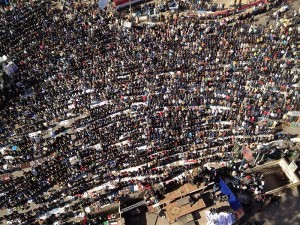
Egyptians praying in Tahrir Square. Photo: wiki commons.
Amid the Arab upheaval of past 18 months, a question has crept among the speeches, demonstrations, riots, elections, battles and massacres – Is Israel better off, or worse off, for the revolution among its neighbors?
Certainly Wael Ghonim of Google, and the positive nature of the short-lived “Arab Spring” raised people’s hopes. The West convinced itself that education and modern social media had created an Arab body politic ready for democratic governance. Very quickly, however, what we got was:
- “Moderate” Islamists — looking less moderate every day — ruling Tunisia;
- A split in the Egyptian Parliament between the Muslim Brotherhood and the Salafists (with “Google people” barely noticeable in the constellation);
- A horrific war in Syria where Saudi Arabia and Qatar are arming an increasingly Islamist-looking opposition (which is what you get when they are armed by a Wahabi regime);
- Sectarian fighting in an increasingly fragile Lebanon;
- Turkey looking increasingly stridently Islamist;
- Muslim Brotherhood demonstrations on a regular basis in Jordan;
- Governmental gridlock in Iraq with an increase in violence;
- Factional fighting in Yemen, with an overlay of al Qaeda activity and American drone strikes;
- Factional fighting in Libya and the spread of Gaddafi’s arsenal across North Africa;
- A simmering rebellion in Bahrain; and, of course,
- Iran, which is both the same as and different from, the other threats.
The last time Israel was surrounded by this much hostility was June 1967 – with the hostility directed toward Israel.
As we commemorate the 45th anniversary of the Six Day War (on the English calendar) it is hard to remember now that Israel then faced annihilation. The forces arrayed against it were staggering: Egypt, Syria, Jordan, Iraq, Algeria, Saudi Arabia, Sudan, Tunisia, Libya, and Morocco.
Israel, with 240,000 soldiers, 800 tanks and 300 aircraft, was facing 550,000 Arab soldiers with 2500 tanks and 950 planes.
Israel has been threatened since birth by Arab politics in all its forms. Sometimes they send their armies to do battle. Sometimes they use terrorism. Sometimes rockets. Sometimes BDS. Sometimes what threatens Israel is the instability or potential fallout from internecine Arab warfare – as in 1970 when Palestinians threatened King Hussein; and 1991, when Saddam used rockets against Israel during a war in which Israel was not involved.
Yes, concerns in the Gulf about Iran have given rise to a certain level of cooperation between Gulf States and Israel. And yes, Jordan and Egypt signed peace treaties with Israel. But even then, the Arab states have unswervingly refused to create conditions in which Israel could live as a normal neighbor. Mubarak “kept the peace treaty,” but allowed rampant anti-Semitism to fester, and ensured that his people would never see peace with Israel as beneficial to Egypt. Egyptians, however, understood that their dictator was kept in place by American military assistance related to keeping the peace with Israel – making Israel and the U.S. perversely responsible for the dreadful dictatorship under which the Egyptian people suffered.
Regime changes in the Arab world are not moving from bad to good, or good to bad. From Israel’s point of view, they are merely variations on the theme of Arab unwillingness to accept the State of Israel as a legitimate, permanent state in the region. Unless and until that changes, the “Arab Spring” is just another phase of the Arab war against Israel, against which Israel will have to defend itself.