







Book: American Jews Are Endangered Species
Error: Contact form not found.

 by Jack Riemer / JNS.org

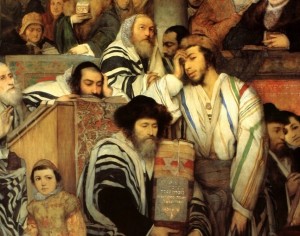
All illustration of Jews praying in synagogue on Yom Kippur. Photo: Maurycy Gottlieb.
JNS.org – Let the general reader be warned: Shaul Magid’s new book, “American Post-Judaism,” is not easy to read. The writing is dense, and the argument is complex. But the book is worth the effort, for it deals with the reality of American Jewish life with realism and with insight.
Magid begins with the proposition that we now live in a post-halachic, post-Holocaust, post-ethnic, post-Judaism, and even post-monotheistic world. He claims that the liberal movements within Judaism have had their day, that the focus on peoplehood will not endure much longer outside of Israel, and that only an uncompromising Orthodoxy and an innovative Jewish renewal movement will survive.
The book is partly sociology and history, and partly religious conviction. It studies the thought of Felix Adler, who formed the Ethical Cultural Movement, and of his contemporary Mordecai Kaplan, who founded Reconstructionist Judaism, and sets both of them within the context of the American culture of their time. It studies the ArtScroll phenomenon, in which books that had never needed to be translated before are now published in English translation for the sake of a new kind of reader—uneducated and illiterate, but hungry for some kind of piety. It studies the way that the Sephardic Jews in Israel brought with them an attachment, and even an adoration, for the saints of their community, and how this has helped them maintain their dignity and sense of self in the secular modern state of Israel.
Magid shows the roots within American culture for the panentheism (the belief that the world is part, but not all of God) that characterizes the thinking of Rabbis Zalman Schachter-Shlomi and Arthur Green, and that he sees as the core of “new age” Judaism. He studies the effect of the Holocaust on American Jewry, which could not understand it within the context of the classic Jewish religious explanation for suffering, and therefore strove to instead understand it within the framework of destruction and renewal. But Magid argues that this American Jewish belief system could not ultimately survive, because when it came to both the Holocaust and the establishment of the state of Israel, American Jews could only relate to those events as vicarious observers. A community cannot exist on vicarious achievements for long, Magid believes.
The most moving chapter in the book is on the inspiring yet tragic life of Rabbi Shlomo Carlebach, who together with his friend, Rabbi Zalman Schachter-Shlomi, was sent by the Lubavitcher Rebbe to campuses around the U.S. to reach college students. It was probably the first of the outreach programs that have made Chabad-Lubavitch the widespread movement that it is. But neither Carlebach nor Schachter-Shlomi remained within the Hassidic fold. As Schachter-Shlomi tactfully put it, “I graduated from Chabad.”
Carlebach became, and in some sense still is, one of the most influential voices in American Jewish life. He spent his life traveling from one campus to another, one synagogue to another, and one stage to another. He brought music and stories and Torah from the Hassidic rebbes to young people who saw the worship in their parents’ synagogues to be boring and meaningless. He created a mythical, romanticized version of Eastern European Judaism that became a kind of a never-never land for this new generation of young American Jews. Eventually his music permeated the synagogues that these kids had come from and transformed them. And yet, at his innermost core, Carlebach remained terribly lonely, terribly alone. Magid tells of how he would come to sing once a year in the Boston suburb of Woburn, and of how, as he bent over to attach his tape recorder to Carlebach’s microphone, Magid overheard him saying to himself, “Okay, chevra, let’s pretend we’re happy.”
Magid is surely correct that rapid changes, monumental changes, are taking place within American Jewry. There is no way of knowing whether Magid’s portrait of what will endure will turn out to be right or not, but his claim is surely a bold one. If you can work your way through his technical terminology and his abstract language, his argument is surely worth studying.
I suggest that you put this book on your shelf for a decade or two and then reread it. Magid just may turn out to be right.
Rabbi Jack Riemer writes frequently for journals of Jewish and general thought in America and abroad.
“American Post-Judaism,” by Shaul Magid, Indiana University Press, April 2013, 388 pages.