






Doubling Down on a Muddled Foreign Policy
Error: Contact form not found.

 by John Bolton

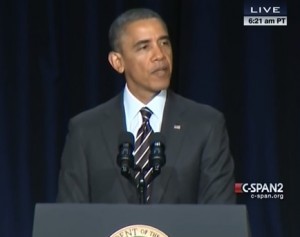
President Obama at the National Prayer Breakfast. Photo: Screenshot.
At West Point on Wednesday, President Obama told the graduating seniors that he had discovered a middle way in foreign policy between isolationism and military interventionism. To the White House, this was like “the dawn come up like thunder outer China,” in Kipling’s phrase.
Others were less impressed, especially since it took five-plus years of on-the-job training to grasp this platitude. Of course the United States has options between war and complete inaction. Not since Nixon has a president so relished uncovering middling alternatives between competing straw men.
When any president speaks, he engages in more than academic analysis. But playing with words, at which Mr. Obama excels, improves nothing in his record. Inattention to foreign threats and challenges as diverse as Islamic terrorism or China’s increasing belligerence in the East Asian littoral; inconsistency and ineptitude in pursuing his own policies, as in Syria and Libya; and indecisiveness in confronting threats like Russia’s pressure on Ukraine and Iran’s nuclear-weapons program all hang like albatrosses around his presidential tenure. Mr. Obama’s speech only further muddled the administration’s contradictory messages on foreign policy.
The president’s “vision” was, as the White House had promised, “both interventionist and internationalist but not isolationist or unilateralist,” a formulation as sterile as the speech itself. Unilateralism vs. multilateralism and interventionism vs. noninterventionism are debates over tools, not over broad philosophies or even strategies. It is like arguing abstractly whether one favors eating with spoons or forks. An essential question must be addressed first: What is the objective? The choice of tactics and methods flows from defining the objectives, not the reverse.
The internationalist/isolationist spectrum does, however, touch on fundamental questions. While Mr. Obama has wisely chosen the “internationalist” bumper sticker for his administration, his actual policies have had strong isolationist elements. Mr. Obama has been weak and ineffectual because of his debilitating reluctance to use the wide range of assets available to advance American interests, not just because of his punctiliousness about using military force. Even as he advocated at West Point the uncontroversial notion that diplomacy and “soft power” are the preferred approaches, while holding military force in reserve, Mr. Obama’s own record demonstrates neither resolute policies, nor effective diplomacy, nor a credible threat.
Consider Syria, where Mr. Obama clearly hoped to make news with his speech by announcing yet another change in policy: increased U.S. assistance for moderate opposition forces, implicitly including military training. The move comes about three years after such training might actually have made a difference. While momentum in that grinding conflict has shifted too often to be confident that anyone now has the upper hand, the Bashar Assad regime is presently stronger than at any point since hostilities began. Moreover, in today’s circumstances, Americans might perversely be training terrorists who have flocked to Syria.
On Tuesday, to avoid stepping on his West Point headline, Mr. Obama announced that he would withdraw all U.S. forces from Afghanistan by the end of 2016, before he leaves office. Resources “saved” thereby will be allocated to counterterrorism training in other countries, as if redistributing scarcity were a virtue. Typically, Mr. Obama made no mention of seeking “victory” in the war against terrorism, a still-foreign concept to him, in a war whose very existence he denies.
What explains Mr. Obama’s too-little, too-late Syria policy? Or his determination in Afghanistan to replicate his mistake in exiting Iraq? Or his neglect of Iranian and North Korean nuclear proliferation? Or—as Yul Brynner said in “The King and I”—”et cetera, et cetera, et cetera”?
Mr. Obama has somehow managed to combine the worst features of isolationism and multilateralism.
He is isolationist in rejecting the extensive, muscular projection of American power and influence, not just militarily, but in the broadest sense of active leadership to guard or advance U.S. interests around the world. Even the president’s supporters are hard-pressed to name a single piece of geography where America has increased its influence and power, let alone its security, under his leadership. (And, not coincidentally, his personal approval ratings globally are falling.)
Greater American geopolitical clout is not the president’s goal. Instead, he and both of his secretaries of state have preferred multilateral agreements on climate change, greater dependence on international law (as Mr. Obama repeatedly emphasized to Vladimir Putin during the Ukraine crisis), or fruitless negotiations over Syria or Iran’s nuclear-weapons program in U.N. venues like Geneva and Vienna. These are the emblems by which Mr. Obama establishes his “internationalist” bona fides.
Critically, what Mr. Obama’s isolationist strain and his multilateralist strain have in common is that both envisage declining American influence. We have reduced influence because we are most emphatically doing less on our own initiative, visible in the president’s propensity for studied inactivity abroad. And we have reduced influence because when we do act, we are too often caught in glacial processes that essentially guarantee that the U.S. will not achieve all its objectives. If not letting America have its own way is Mr. Obama’s objective, he is an unparalleled foreign-policy success.
Mr. Bolton is a senior fellow at the American Enterprise Institute and the author of Surrender Is Not an Option: Defending America at the United Nations and Abroad (Simon & Schuster, 2007). This article was originally published by The Wall Street Journal.


