








After Hajj, Israel Actively Works to Prevent MERS and Ebola Outbreaks
Error: Contact form not found.

 by Tzvi Zucker / Tazpit News Agency

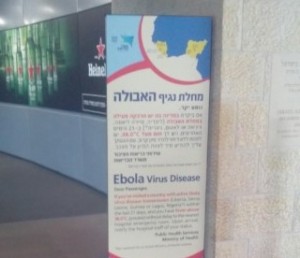
Ebola poster at Ben-Gurion airport. Photo: Rotter.net
More than 5,000 Israeli Arabs are estimated to make the Hajj pilgrimage to Saudi Arabia each year. This past year, 2,200 Gazans also made the trip, according to the Palestinian Authority’s Ministry of the Interior. The Hajj, one of the five pillars of Islam, took place from October 3-7.
MERS (Middle Eastern Respiratory Syndrome) is a principle health concern of the Hajj. If any of the attendees contract it, they can spread it to everyone they come in contact with when they return home. From a virologist’s perspective, this is a nightmare.
MERS is a relatively new disease, having recently evolved to be able to infect humans. Until now, the disease was found in camels and bats. The first human case was discovered in a Saudi Arabian man. It has since been reported in various countries but seems to be most present in Saudi Arabia, with more than 688 cases reported there. The disease has a mortality rate of 40% – making it one of the most deadly in the world.
As part of their efforts to prevent an outbreak, the Israeli Ministry of Health circulated an information packet and treatment guidelines throughout the country. There have been no MERS cases reported in Israel to date. Besides working to prevent contagion from the Hajj, the Ministry of Health is also cooperating with the Ministry of Agriculture in studying MERS exposure in animals, the spokesperson told Tazpit News
Besides MERS, the recent outbreak of Ebola in West Africa is also on the radar of Israeli health authorities. Despite recent tensions, Israel and the Palestinian Authority are coordinating their efforts to prevent the Ebola virus from entering the region. Detection equipment was given to the Palestinian Authority for use at the Allenby Border Crossing with Jordan and the Rafah Crossing between Gaza and Egypt. The equipment includes lab kits, hazmat protective suits, and a thermometer that can measure a person’s temperature without bodily contact.
Protocols and regular meetings to discuss the issue were agreed upon between the Coordinator of Government Activities in the Territories (COGAT) and the Palestinian Minister of Civilian Affairs. The Gaza Health Ministry will attend the meetings as well. Palestinians suspected of being infected with Ebola will be sent to the hospital in Jericho. Lab samples will be sent from Jericho to the World Health Organization. From the Israeli perspective, besides being a potentially lifesaving measure for residents in Gaza, Judea, and Samaria, Israeli-Palestinian cooperation will also help prevent the spread of these diseases into Israel itself, keeping the public safe and healthy.