









Palestinian Statehood: An Idea Whose Time Has Passed
Error: Contact form not found.

 by Stephen M. Flatow / JNS.org

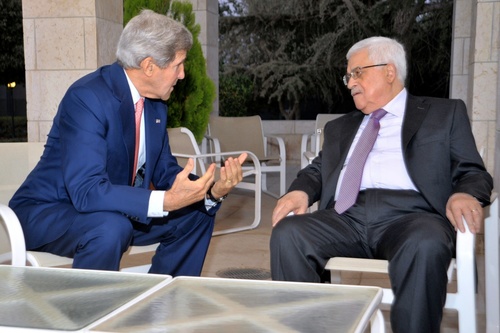
US Secretary of State John Kerry and Palestinian Authority President Mahmoud Abbas. Photo: Department of State.
JNS.org – John Kerry and J Street are worried — because they see their cherished dream of a Palestinian state slipping away.
Kerry’s criticism of Israel at the Saban Forum on December 4 attracted a lot of attention. But the transcript of his remarks reveals an important moment that the media overlooked. Just as he was about to denounce Israel’s policies, Kerry suddenly turned to the audience and said:
“By the way, just let me ask a question. Raise your hands. I mean, I know some of you may not want to acknowledge it, but how many of you believe in a two-state solution, believe two states is critical? Okay, it’s the vast majority of people here. How many of you don’t — are willing to say so? There’s one hand up, one, two — maybe a few of you don’t want to say.”
Kerry is clearly worried that public support for Palestinian statehood is slipping away.
And he’s not the only one. Last week, J Street sent a letter to its supporters in which it complained that the Republican Party left Palestinian statehood out of its platform this year, and that the American Israel Public Affairs Committee reportedly left the issue out of a talking points sheet that it recently distributed.
Here’s another reason for Kerry and J Street to worry. Speaking at the Jewish Media Summit in Jerusalem — also on December 4, Israeli MK Michael Oren said that the election of Donald Trump “spells the end of the two-state solution.” Oren is not some extremist. He is the widely respected former Israeli ambassador to the US, a representative of the moderate Kulanu Party, and himself a supporter of Palestinian statehood (with certain limitations).
It’s time to read the writing on the wall: Palestinian statehood is an idea whose time has passed.
But it’s not as if creating a Palestinian state is some kind of cherished principle that has been recognized and supported by everybody since time immemorial. In fact, it’s a very recent proposal, and it has always been fraught with problems.
There have been 12 US presidents since 1948. Only two (George W. Bush and Barack Obama) advocated creating a Palestinian state.
I’m not including those who advocated Palestinian statehood after they left office, namely Jimmy Carter and Bill Clinton. When presidents are in office, they need to deal with the real world, which is why a bad idea like creating a Palestinian state has never come to fruition. Once presidents no longer have to deal with real-world consequences, they feel free to advocate any irresponsible policy that suits their post-presidential convenience.
There have been 12 different Israeli prime ministers since the Jewish state was established in 1948. Only two of them (Ariel Sharon and Ehud Olmert) advocated creating a Palestinian state. I’m not including Benjamin Netanyahu, because his concept of a fully demilitarized “Palestine” that accepts Israel as a Jewish state is so far removed from what the Palestinians and their supporters demand, that his position is really only hypothetical.
There have always been two arguments in favor of creating a Palestinian state. Neither of them has withstood the test of time.
The first was that Yasser Arafat and the Palestinian Arabs had given up their goal of destroying Israel and had forsaken terrorism. According to this argument, they had changed their ways, so they could be trusted with their own state in Israel’s backyard.
This argument faced two major tests, and failed both times. President George H.W. Bush accepted this argument shortly after his election in 1988, and recognized Arafat and the Palestine Liberation Organization. Eighteen months later, when a major PLO faction tried to attack Israeli beachgoers in Tel Aviv and the nearby US embassy, Bush realized he had been wrong and ended his relationship with Arafat. Then the US recognized Arafat and the PLO a second time, after the Oslo Accords were signed in 1993. That blew up when Arafat tried to smuggle 50 tons of weapons into Gaza on the Karine A in 2002.
The second argument for a Palestinian state was what became known as the “demographic time bomb” — the claim that because of the high Arab birthrate, Israel would need to agree to a Palestinian state or will become an apartheid-like ruler over the Palestinians. Yitzhak Rabin resolved that problem. In 1995, he withdrew Israel’s forces from the cities where 98 percent of the Palestinians reside. Now they are residents of the Palestinian Authority, and they vote in Palestinian elections. They will never be Israeli citizens, will never vote in Israeli elections and will never threaten Israel’s Jewish demographic majority.
So Arafat settled the first debate, and Rabin settled the second. It is now plain as day that the Palestinians have not given up terrorism or forsaken their goal of destroying Israel, and would use a Palestinian state to advance that goal.
There may be no solution to the Israeli-Palestinian conflict in our generation; not all international conflicts have solutions. One thing has now become clear: a Palestinian state next to Israel is not the solution.
Stephen M. Flatow, a New Jersey attorney, is vice president of the Religious Zionists of America and the father of Alisa Flatow, who was murdered by Palestinian terrorists in 1995.


