


Did Vatican II Get Islam Right?
Error: Contact form not found.

 by Dexter Van Zile

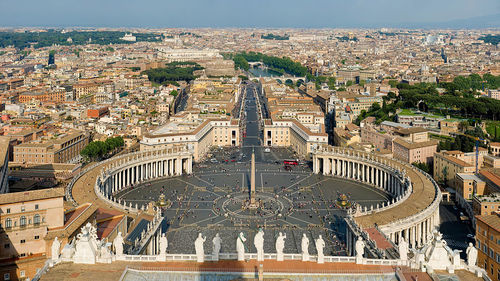
Vatican City. Photo: Wikimedia Commons.
Pope Francis’ recent decision to allow Mahmoud Abbas to set up an embassy in the Holy See raises questions about just how serious the Vatican is in its efforts to abide by the teachings of Nostra Aetate, a Papal Encyclical issued by Pope Paul VI in 1965.
This document, prepared by the Second Vatican Council, declares that the Catholic Church no longer holds the Jewish people in contempt, and “decries hatred, persecutions, displays of anti-Semitism, directed against Jews at any time and by anyone.” Sadly, this litany of sins against the Jewish people is a pretty good description of what Palestinian leaders have done over the past few decades.
The Grand Mufti of Jerusalem persecuted Jews by inciting riots against them in the 1920s and 30s, recruiting soldiers for Hitler’s genocidal armies during World War II and broadcasting Jew-hatred into the Middle East during and after the Holocaust.
Yasser Arafat promoted vicious antisemitism as the leader of the PLO, and called for the destruction of Israel even while he was negotiating with Israel during the Oslo “peace” process. “We will not bend or fail until the blood of every last Jew from the youngest child to the oldest elder is spilt to redeem our land,” he said in 1996.
And Mahmoud Abbas, the current president of the Palestinian Authority, downplayed the Holocaust in his Ph.D. dissertation, has incited Palestinians to violence time and time again and has railed about the Jews and their “filthy feet” contaminating the Temple Mount, a Jewish holy site, no less.
And then there’s Hamas, whose leaders regularly say hateful things about Jews and call for Israel’s destruction.
Despite all of this history — which clearly contradicts Nostra Aetate’s prohibition against antisemitic hostility — Pope Francis is rewarding Palestinian leaders with the trappings of statehood.
In order to understand how such a thing could happen, one has to look closely at the entire text of Nostra Aetate, not just the part about Jews and antisemitism. There’s a section that says the Church regards Muslims with “esteem,” because they adore the one God and, among other things, “worship God especially through prayer, almsgiving and fasting.”
Nostra Aetate makes no mention however of the Jew-hatred that is sadly enough embedded in the sources that Muslims hold dear. A close look at the Koran, the Hadiths (sayings of Mohammed) and Mohammed’s biography reveals texts that promote the Jew-hatred condemned by Nostra Aetate.
The Koran declares that Allah hates Jews for their sins, and the Hadiths say that the untrustworthy and defiant Jews rewrote their scriptures. Mohammed’s biography blames a Jewish woman for his death, leveling an accusation similar to the deicide charge in the Christian faith.
Clearly, there is a contradiction inherent in Nostra Aetate. On one hand, the document condemns Jew-hatred “at any time and by anyone,” and on the other hand, it proclaims esteem for the adherents of a religion whose sources clearly promote Jew-hatred.
This contradiction played itself out in Pope Francis’ overtures to Palestinian leaders who defame the Jewish people on a regular basis. Apparently, under the current reading of Nostra Aetate, Catholic leaders can condemn antisemitism while appeasing Muslims who promote Jew-hatred.
There’s another problem. While Nostra Aetate declares that the Church holds Muslims in esteem, this esteem is, in many instances, met with real contempt and hostility. Anti-Christian hostility is, like Jew-hatred, embedded in Islamic sources, which demand that Muslims dominate Christians (and Jews) whenever they have the power to do so.
By declaring that the Catholic Church holds Muslims in esteem — without confronting them on the supremacism that is inherent in the sources that Muslims hold dear — Nostra Aetate encourages a heretical attitude of submission toward the oppression Christians endure in Muslim-majority environments. Declaring one’s esteem for someone intent on destroying you is theological suicide.
In sum, for all its obvious and undeniable benefits in the realm of Christian-Jewish relations, Nostra Aetate may have placed the Catholic Church at an impossible disadvantage when dealing with the issue of Muslim supremacism and its role in promoting Jew-hatred and the oppression of Christians in the Middle East, Africa and Asia.
When Nostra Aetate was enunciated in the mid-1960s, it was a faithful expression of how Christians should respond to the Church’s history of antisemitism. But a lot has happened in the years since 1965. It is time for religious leaders of all stripes to come to grips with these events and their impact on theology.