






Long-Lost Recordings of Songs Sung by Jews in Nazi Concentration Camps Recovered in Archive After Going Missing for Decades
Error: Contact form not found.

 by Ruthie Blum


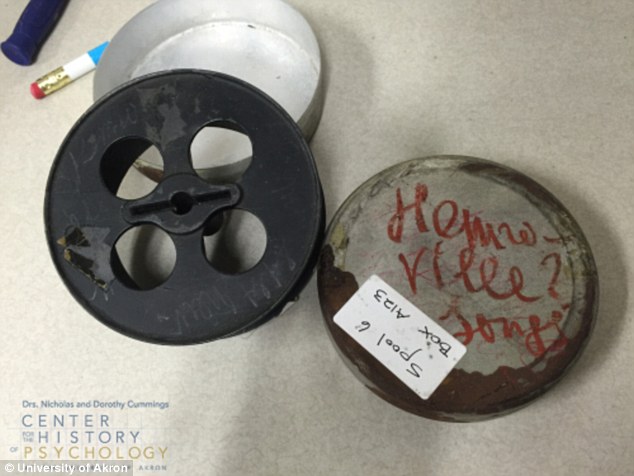
A photo of the lost spool. Photo: University of Akron.
A long-lost wire spool — containing recordings of German songs that Jewish prisoners in Nazi concentration camps were forced to sing, and Yiddish songs they sang in rebellion – was recently located by accident in the University of Akron archive where it had been mislabeled, the UK’s Daily Mail reported on Friday.
According to the report, the retrieved spool was one of a set of 200 recordings of interviews conducted right after World War II with displaced Holocaust survivors in Germany, Italy, France, and Switzerland. The interviews, with at least 130 Jews, were conducted by Dr. David Boder in 1946 for the purpose of preserving the history of the “unspeakable horrors” they had endured at the hands of the Nazis. During Boder’s talks with the survivors, some recounted and sang the songs in question.
According to the Daily Mail, all the oral histories that Boder recorded were transferred in 1967 to the Nicholas and Dorothy Cummings Center for the History of Psychology at the University of Akron in Ohio.
Because Boder had mentioned the songs, recorded at a refugee camp in Henonville, France, in his subsequent writings, researchers were puzzled as to why they did not feature on any of the spools. The mystery was solved when media digitizer Jon Endres sifted through the three boxes in the Cummings Center archive that contained the recordings and came upon a spool that had mistakenly been entered into the system with a typo. Rather than being filed as the “Henonville Songs,” it was labeled as the “Heroville Songs.”
After digitizing the recording, Endres wrote in a blog post, he was “blown away.”
Dr. David Baker, the Margaret Clark Moran Executive Director of the Cummings Center, said of the find: “I think it is one of the most important discoveries from our collections in our 50-year history. That we could give the world the melody to a song sung by those sentenced to their death through forced labor during one of the most unspeakable horrors of the 20th century is remarkable.”
One example of such a song is “Undzer shtetl brent” (Our Village is Burning) by Mordecai Gebirtig, performed by Gita Frank, who explains in the introduction that it was once sung by the composer’s daughter in the cellars of a Krakow ghetto. Intended to inspire Jews to rebel against the Germans, the original words were changed to “The Jewish People Are Burning.”
Watch Baker discuss the find in the video below: