

Kurdish Factions Turn Guns on Each Other in Yazidi Homeland
Error: Contact form not found.

 by John Rossomando

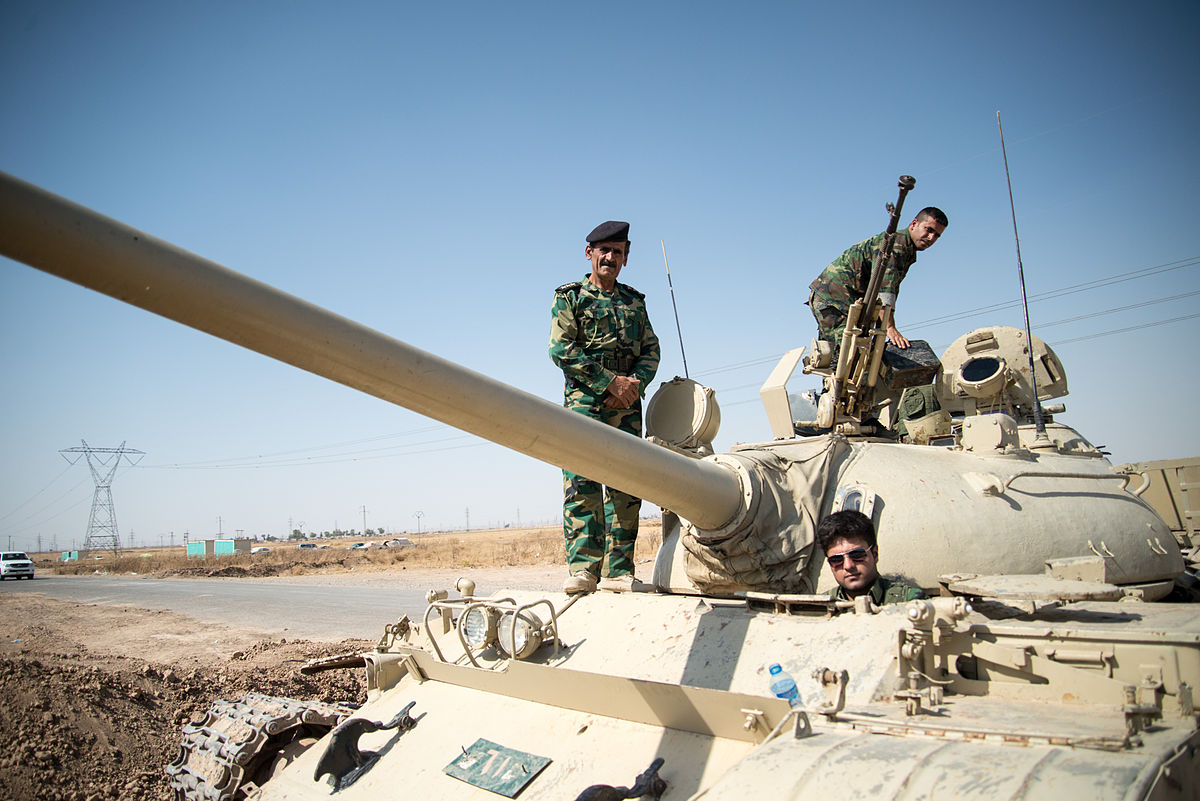
Peshmerga T-55 tank outside Kirkuk on 19 June 2014.. Photo: Wikipedia.
Yazidis living in Iraq’s Sinjar region are on edge, due to fighting last week between rival Kurdish factions — forces aligned with the Kurdistan Regional Government (KRG) and those aligned with the PKK.
Some Yazidis, who are ethnic Kurds, believe that the KRG failed to protect them from marauding ISIS fighters in 2014, leading to a genocide.
The KRG denies deliberately abandoning the Yazidis, saying that ISIS simply overran the KRG’s Peshmerga’s positions.
On Monday, the Yazidi-dominated Shengal (Sinjar) Constituent Assembly released a statement asking the United Nations and other “benevolent” states to intervene and end the fighting.
“Don’t let the [Yazidis] suffer through another massacre,” the Assembly statement said. “We are also calling on the UN to stop their aid for the [P]eshmerga. Because most of the aid the [P]eshmerga receive are supposed to be for [Yazidis], but the aid and weapons and ammunition are used against [us].”
The recent round of fighting erupted last Thursday night in Iraq’s Sinjar region — near the Syrian border — when Peshmerga forces loyal to KRG President Masoud Barzani clashed with those aligned with the Marxist-Leninist PKK — a Kurdish group fighting for independence from Turkey. These clashes came days after Turkish President Recep Tayyip Erdogan met with Barzani in Ankara, and greeted him with full diplomatic honors.
The fighting puts the United States in an awkward position because the KRG and the Syrian Kurdish factions aligned with the PKK all receive American support. (The State Department classifies the PKK itself as a terrorist group.)
Only a handful of casualties were reported in the most recent fighting.
A Facebook account aligned with the PKK posted the pictures of four men it identified as Yazidis who were killed in clashes with the Peshmerga. The pro-KRG outlet Basnews likewise reported that four PKK commanders were killed in the fighting.
If the KRG ultimately declares independence, the PKK-aligned groups — including their Yazidi allies, the Sinjar Resistance Units (YBS), under the leadership of the Shengal Constituent Assembly — will resist. This could lead to further bloodshed.
The Shengal Constituent Assembly statement demanded that the Peshmerga withdraw from the region, saying that those who “abandoned our people in August 2014, stay away. Nobody has forgotten about that.”
Many Yazidis feel a debt of gratitude to the PKK for rescuing them from ISIS after the Peshmerga withdrew in 2014, Georgia State University Professor Benjamin Kweskin told the Investigative Project on Terrorism. Even KRG leader Barzani acknowledged the PKK’s role in rescuing the Yazidis when he visited a Yazidi camp in August 2014.
“The KRG as a political entity has not had a good relationship with the Yazidis, specifically in Sinjar,” Kweskin said. “For the majority of the Sinjari Yazidis, they see and saw the PKK as being their saviors.”
For its part, the KRG accuses the PKK of playing a destabilizing role in Sinjar. The KRG asserts that it has the right to mobilize its Peshmerga forces whenever and wherever it wants. This includes the Sinjar region, even though it lies outside the KRG’s established official borders due to a never-implemented provision of Iraq’s 2003 constitution.
“The KRG has a legitimate concern about the PKK’s presence in Sinjar and the destabilizing and divisive role it is playing among the [Yazidi] community,” KRG spokesman Alex Ebsary said in an emailed statement. “However, we and the majority of the [Yazidi] community ask that the PKK and its affiliates withdraw from Sinjar and allow the process of reconstruction and reconciliation to go ahead. The well-being of the [Yazidis] and all the people of Sinjar is our priority.”
Mir Tahsin Beg, a Yazidi leader, echoed the KRG and urged the PKK to leave Sinjar and stop attacking the Peshmerga. He also disagreed with the Shengal Constituent Assembly, saying that Sinjar should be controlled by the KRG.
The Turks desperately want to remove the PKK and its Syrian allies from Iraqi soil. Turkish Defense Minister Fikri Isik said on Friday that his government expects them to return to Syrian territory.
Similarly, Erdogan warned in October that Turkey would not let the PKK turn the Sinjar region into a stronghold. Turkish Deputy Prime Minister Veysi Kaynak reinforced that statement in December, warning that Turkey would directly intervene if “Barzani did not get the PKK out of Sinjar [Shingal].”
The Shengal Constituent Assembly likewise blamed Turkey for last week’s Peshmerga attack against the PKK-aligned forces.
Meanwhile, KRG forces blame Iran for the skirmish. The PKK and its allies receive salaries from the Iranian-backed Shiite militia coalition known as Hasd al-Shaabi, which has been formally sanctioned by Iraq’s government in Baghdad.
Some officials speculate that the Kurdish fighting has simply become a proxy war between Turkey and Iran.