



Veterans Affairs Is New Frontier in the US-Israel Military Relationship
Error: Contact form not found.

 by Lori Lowenthal Marcus / JNS.org

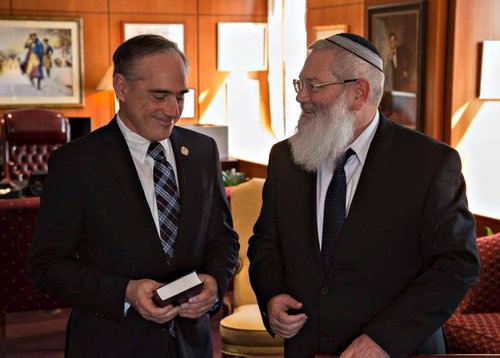
US Secretary of Veterans Affairs David Shulkin (left) and Israeli Deputy Defense Minister Eli Ben-Dahan meet in March. Photo: Gene Russell Photography.
JNS.org – While US-Israeli military ties have long focused on foreign aid packages, intelligence-sharing and jointly developed missile defense technology, veterans affairs could become a major new frontier in that relationship.
The seeds of this added dimension were planted during last year’s US presidential election. Israeli Defense Ministry officials point out that then-candidate Donald Trump significantly focused on issues pertaining to veterans on the campaign trail, and has maintained that focus in the early months of his presidency.
Another development was Trump’s selection of secretary of veterans affairs. Trump’s appointee, David Shulkin, is a Jewish doctor and hospital administrator who was unanimously approved by the Senate — no small feat in this hyper-partisan era.
Within weeks of Shulkin’s confirmation, Israeli Deputy Defense Minister Eli Ben-Dahan and his advisers reached out to the secretary, asking for a meeting. That meeting — the first of its kind between American and Israeli officials responsible for the care of injured and released (or “discharged”) soldiers — took place in late March in Washington, DC. It also marked Shulkin’s first visit with a foreign government official.
“The level of anticipated cooperation brings what has long been a productive relationship [on military affairs] … to a whole new level,” Idit Druyan, an adviser to Ben-Dahan, told JNS.org.
“Shulkin is extremely knowledgeable. He was very welcoming to us and open to listening to our ideas. We were excited by his interest in the work he wants to accomplish, as well as his interest in our expertise,” she added.
In some ways, the systems for working with injured and discharged soldiers in the two countries are very different. Israeli soldiers’ progression from the military health care system to the public health care system happens at the governmental level rather than at the individual’s initiative, as it does in the US.
Yet there are many similarities in the types of medical issues that arise for both American and Israeli veterans. Treatment for post-traumatic stress disorder and suicide prevention are of great interest to both nations, for example.
Further, American officials have asked Israeli leaders to make presentations during international conferences at which Israel is not yet participating. Such opportunities will allow the Israelis to showcase their knowledge on a world stage to which they have, until now, largely been denied access.
Deputy Minister Ben-Dahan is a rabbi and served as an officer in the IDF. He continued serving in the military reserves until age 60, and currently has several children serving in combat units. Before moving into Israel’s Defense Ministry, Ben-Dahan served as deputy minister of religious services.
Although Secretary Shulkin is not a veteran, he was born on a US Army base in Illinois, where his father served as a military psychiatrist. Shulkin served in high-level management roles at several major medical facilities, including as the president and CEO of Beth Israel Medical Center in New York City.
“The fact that Shulkin is Jewish did, naturally, come up during our Washington meeting,” said Druyan, who noted that Shulkin “mentioned that he has been to Israel and that one of his children spent a year in Israel.”
According to Druyan, Shulkin asked the Israeli delegation about their familiarity with Israel-based ReWalk, a robotics company producing exoskeletons to help those with spinal cord injuries. Following the meeting, the US Department of Veterans Affairs purchased 28 ReWalk Personal Exoskeleton Systems to support a national clinical trial in the United States.
The Israeli and American leaders responsible for caring for their respective nations’ soldiers expect to remain in professional contact and to maintain and increase mutually productive endeavors.


