





‘Menashe’ Presents a Rare Authentic, On-Screen Depiction of Hasidic Judaism
Error: Contact form not found.

 by Jane Hanser / JNS.org

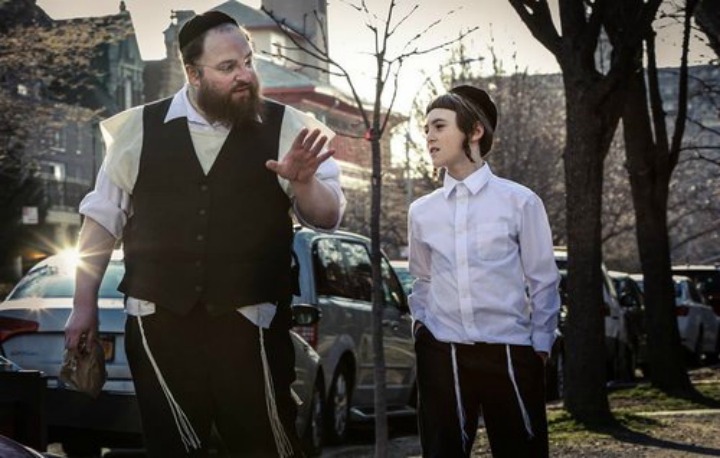
Hasidic father Menashe and his son Rieven in the film “Menashe.” Photo: Federica Valabrega.
JNS.org – In the film Menashe, which debuts across America on July 28, director Joshua Weinstein has delicately crafted a work that emanates a rarely seen authenticity, tenderness and depth sadly lacking in other mainstream films about Hasidic Jews and their communities.
In the film, a Hasidic father named Menashe — who works long hours in a small grocery store in Brooklyn, struggling to make ends meet — has lost his young wife Lea to illness. Their sole child — Rieven, an adolescent — has also become suddenly bereft of his beloved mother. Anchored against the resulting father-and-son relationship is Aizek — Menashe’s former brother-in-law and Rieven’s uncle. He is a successful, but arrogant property owner who seeks custody of the boy to raise him in his own family.
This heart-wrenching triangulated scenario could play out anywhere. But this is Borough Park, home to numerous Hasidic groups, a world unknown — and also misunderstood and misjudged — by many. Filmed on location, this engrossing exploration of love, grief and devotion pulses to the heartbeat of the Hasidic community and its many nuances. In Menashe’s particular community, children must be brought up in a home with a mother, meaning that following his wife’s death, Menashe faces a choice between finding a wife, giving up his son, or violating the community’s tradition.
In the film, spoken almost entirely in Yiddish (with English subtitles), Weinstein sheds layer after layer, and reveals a profound humanity.
The real-life story of the unpretentious Menashe Lustig, who loosely portrays himself in the film, inspired this main character. Lustig is a grocer from New Square, New York. Except for Menashe’s Hispanic co-workers, all of the actors in the film are Hasidim, most of whom have chosen to remain unnamed in the credits. Rieven is portrayed by a boy from London who was studying in an American yeshiva. These casting choices are instrumental to the film’s authenticity.
As Lea’s first yahrzeit approaches, the conflict over custody heats up, framed by the swirling, towering flames of the Lag B’Omer street bonfires, around which the Hasidim have gathered to celebrate, dance and sing.
Menashe is defiant that he can be responsible for his son, but the harder that he tries to prove his worthiness, the more that goes wrong — and the more rebuke and humiliation that the principled Menashe is subjected to. We empathize.
Simple affection from Menashe’s adoring son provides him respite from all these pressures.
Menashe’s humble walk-up apartment where Rieven, the Ruv (communal religious leader), Aizek and several other men have come to share in the yahrzeit meal — complete with “bachelor-proof kugel” — provides the setting for the dramatic climactic scene. Up close and personal, crisp editing masterfully evokes the tension — and high stakes — of this meal. With humor and drama, the community experiences its proudest moment.
From the brilliant opening scene of a dispute over the sale of a head of lettuce in the grocery store where Menashe is employed — to the faint sun’s rays illuminating the early morning netilas yadayim (ritual hand-washing) or a wordless sunset shared by father and son in the park — the camera’s deft touch pulls us into story after story. Weinstein calls these “micro-moments.”
“I think the whole film is like that. … How does a small moment tell a big story?” the director told JNS.org in a joint interview with the soft-spoken Lustig.
The many local characters in the film radiate genuineness, and a strong on-screen presence. Aware of the challenges that Hasidim face today, Weinstein says that he understands that when problems happen, “it’s so easy to leave … I wanted to make a character [who], by definition, never even thought about leaving.”
Lustig and Niborski didn’t know each other when the filming began, so bridging that emotional distance within the film’s story line comes across as real. Lustig exclaims, “I told [Weinstein] that if you put the clothes of my son on [Niborski], he looks like my son! … The child feels to me very close.”
Soulful music by Zusha, a New York-based Hasidic folk and jazz band, vitalizes Menashe with modern wordless niggunim (melodies). The searing melody of a solo violin, scored by Aaron Martin and Dag Rosenqvist, adds color and commentary throughout the film, and heightens the mesmerizing closing scene.
When I asked Weinstein how he chose the ending, Lustig didn’t hesitate to chime in: “My answer is simple — that that’s a real story,” he says, “and the story will continue.”


