


Iran Dramatically Increases Funding to Hezbollah in Wake of Nuclear Deal
Error: Contact form not found.

 by Steven Emerson

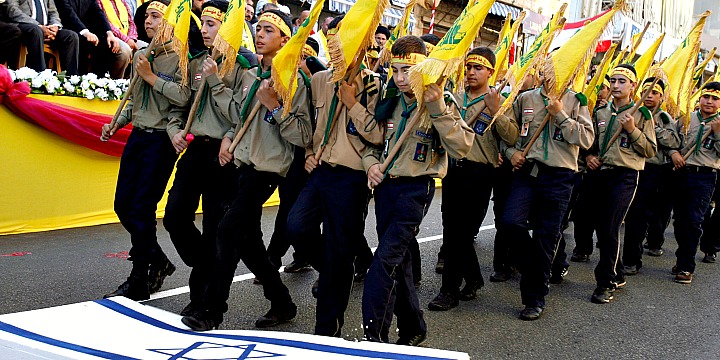
Members of Hezbollah’s youth movement trample on an Israeli flag at a rally in Beirut. Photo: File.
Iran has drastically increased financial support for its Lebanese-based terrorist proxy Hezbollah since the Iran nuclear deal was signed two years ago, the Jerusalem Post reports.
Iran secured $100 billion in frozen assets and sanction relief in January 2016 as a result of the deal with the United States and European countries. Flush with cash, Iran immediately increased its support for terrorist proxies in the region — and nefarious activities worldwide. Hezbollah was receiving $200 million from Iran before the nuclear deal. Now, it’s reportedly $800 million.
Last month, Hamas terrorist leader Yahya Sinwar admitted that “relations with Iran are excellent and Iran is the largest supporter of the [Hamas military wing] Izz el-Deen al-Qassam Brigades with money and arms.” Iran reportedly provides Hamas with about $60-$70 million a year.
Both Hezbollah and Hamas remain dedicated to Israel’s destruction, and continue to invest considerable resources to fight the Jewish state. Iran also spends hundreds of millions of dollars on Shiite militias in Syria and Iraq, while increasing support for Houthi militants in Yemen.
Shortly after the July 2015 nuclear deal was signed, Iran expanded its presence in regional conflicts, and even increased its own intervention in Syria’s civil war, leading to mounting Iranian Revolutionary Guard Corps (IRGC) casualties.
Iran also increased its efforts to subvert its neighbors. In March, Bahrain security authorities arrested members of an Iranian-sponsored terrorist cell, accusing them of planning to assassinate senior government officials. The IRGC reportedly provided military training to several o the cell members.
Beyond Iran’s regional ambitions, it continues to plan terrorist attacks around the world. Earlier this year, for example, Germany accused Iran of plotting attacks on Israeli and Jewish targets.
Proponents of the Iran nuclear deal, including many within the Obama administration, argued that the agreement would moderate Iran’s behavior. On the contrary, Iran immediately enhanced its support for terrorist organizations, while extremist factions within Iran gained more influence. Two years later, Iran has proved to be even more emboldened to pursue its regional hegemonic ambitions, drastically increasing financial and military support to terrorist organizations and cells worldwide.