




How the Israeli Left Views the Palestinians
Error: Contact form not found.

 by Jonathan S. Tobin / JNS.org

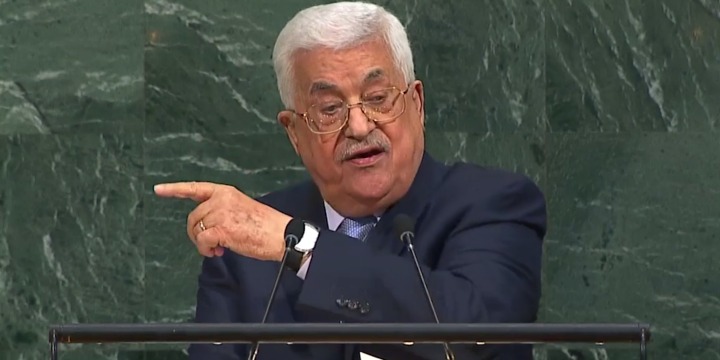
PA President Mahmoud Abbas addresses the UN General Assembly last month. Photo: UN.
JNS.org – Some Jewish institutions in America are under siege these days, and their principal critics aren’t neo-Nazis. Despite the clear leftward tilt of a large part of organized Jewish life, liberal critics are constantly telling us that mainstream groups like AIPAC and Jewish federations are toadies of an Israeli government that is pursuing policies that many American Jews abhor.
The ferment on the Jewish left runs from tame — and largely irrelevant — liberal Zionist groups like J Street, to more extreme opponents like IfNotNow and the virulently anti-Zionist Jewish Voice for Peace, which also dabbles in antisemitic libels and support for boycotts of Israel.
These critics and the naysayers have the ear of many Jews. The reason for this has more to do with the demographic collapse and decline of a sense of Jewish peoplehood among the non-Orthodox denominations that make up about 90 percent of American Jews, than it does with Israeli Prime Minister Benjamin Netanyahu’s shortcomings. But it’s also true that the majority of the non-Orthodox Jewish community has little sympathy with the Israeli government’s positions on the peace process.
The notion promoted by former President Barack Obama — that Israel needs to be saved from itself — still resonates among many Jews who voted for him. This view holds that Israel’s continued presence in the West Bank is the prime obstacle to peace, as well as the future of the Jewish state. But while this liberal consensus deems Netanyahu a problem, its proponents rarely stop to ask why he was elected prime minister four times, including winning the last three elections in a row.
The answer is simple: There exists a broad consensus within Israeli society that contradicts the assumptions held by many American Jews. The majority of Netanyahu’s compatriots see his policies as the only possible response to a Palestinian political culture that still refuses to accept the legitimacy of a Jewish state, no matter where its borders might be drawn.
Moreover, that Israeli consensus isn’t merely upheld by Netanyahu and his allies; his rivals on the center and the left also embrace it.
The latest example of this fact came this week from the new Zionist Union party leader, Avi Gabbay. The Zionist Union is a coalition of parties that includes Labor, which was once the dominant faction in Israeli politics — and the embodiment of the center-left ethos that American Jews tend to identify as representative of the Israel they’d like to support.
The Zionist Union is the largest opposition party in the Knesset, and its poll numbers have been on the rise since Gabbay beat former leader Isaac Herzog in a primary earlier this year. Along with the centrist Yesh Atid party’s Yair Lapid, Gabbay is the man who would most likely replace Netanyahu in the next election — assuming that Netanyahu survives corruption probes and is able to run again.
But on the Palestinian issue, Gabbay offers nothing that is very different from Netanyahu.
This week, Gabbay said that he wouldn’t uproot any settlements as part of a peace deal with the Palestinians. If peace does become possible, Gabbay thinks that the settlements should remain in place. That’s exactly what Netanyahu — who likens the desire of the Palestinians and their foreign supporters to destroy Jewish communities in Judea and Samaria to ethnic cleansing — also believes.
Earlier in the year, both Lapid and Herzog, Gabbay’s predecessor, also made it clear neither of them saw real peace with the Palestinians as a possibility for the foreseeable future. Herzog thought that it would take 10 years for the Palestinians to demonstrate that they had sufficiently altered their political culture to make peace with a Jewish state possible. Lapid said that it would take 20 years. That’s in line with Netanyahu’s belief that while peace and even withdrawal from some territory might someday be necessary, any such move must await a sea change in Palestinian society that would reject violence and the delegitimization of Zionism.
There are some voices on the left saying that Lapid and Gabbay are just posturing to gain support from centrist voters and would, in fact, pursue very different policies if elected. They may be right about that. But if so, that merely shows both men understand how most Israelis still see more Israeli withdrawals unaccompanied by genuine change among Palestinians as insane, not just misguided.
Finally, Gabbay’s posturing also poses a more important question for liberal Americans: What do you think you know about the conflict that Israelis don’t know? It’s time for those American Jews who supported Obama’s policies on Israel to show some humility and acknowledge that the answer is, not much.
Jonathan S. Tobin is opinion editor of JNS.org and a contributing writer for National Review. Follow him on Twitter at: @jonathans_tobin.