







Sochi Meeting Hangs Over Last Day of Syrian Peace Talks
Error: Contact form not found.

 by Reuters and Algemeiner Staff

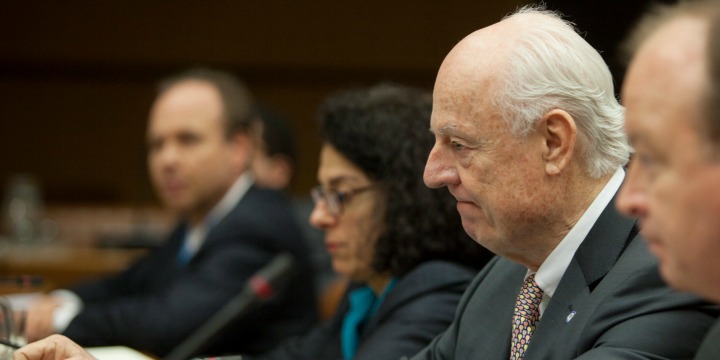
UN envoy Staffan de Mistura (C) looks on before the start of talks on Syria in Vienna, Jan. 25, 2018. Photo: Reuters / Alex Halada / Pool.
The Syrian opposition may decide on Friday whether to attend peace negotiations next week hosted by Damascus’s close ally, Russia, an opposition spokesman said.
His comments came as negotiators settled in for a long, final day at separate UN-mediated talks in Vienna aimed at ending Syria’s civil war, in which hundreds of thousands have died and 11 million have been driven from their homes.
The UN-brokered talks — of which this is the ninth round — have made little progress so far.
Having regained the upper hand on the battlefield after nearly seven years of conflict, Syrian President Bashar al-Assad appears unwilling to negotiate with his enemies at all, let alone step down as part of any peaceful solution as rebel groups have demanded.
Arriving at the UN offices in Vienna on Friday morning, the talks’ host, UN Special Envoy for Syria Staffan de Mistura, told reporters he expected “a long meeting.”
With a breakthrough unlikely, a question at the center of Friday’s discussions was whether the opposition will attend a Syria peace conference next week in the Russian Black Sea resort town of Sochi, which Moscow announced after the last round of UN talks in December.
Western powers and some Arab states believe Sochi is an attempt to create a parallel political track that would undermine the United Nations and lay groundwork for a solution more suitable to the Damascus government and its allies.
“We will tell you today, hopefully,” opposition spokesman Yahya Aridi told reporters as his delegation arrived, when asked if the opposition would attend Sochi.
The warring sides have not spoken face to face — a Syrian government delegation was due to meet De Mistura in the afternoon. De Mistura was expected to make a statement at the end of the talks.
Neither side has commented on the content of this week’s closed-door talks.
Previous rounds have taken place sporadically in Geneva, with a mandate to discuss new elections, reformed governance, a new constitution and the fight against terrorism.
At the last round in December, the Syrian government delegation objected to the opposition’s tough line on the future of Assad, and those talks achieved nothing.
Syrian government forces are pursuing offensives against two remaining rebel pockets, Idlib in the northwest and eastern Ghouta near Damascus. Turkey has poured troops into the north to fight Kurdish militias that have established regional autonomy and are seen by Ankara as a menace to its security.