







Examining BDS and Other Anti-Israel Hate at Oberlin
Error: Contact form not found.

 by Melissa Landa

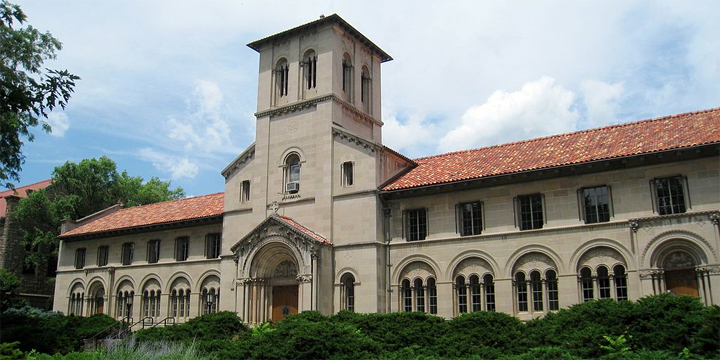
Bosworth Hall at Oberlin College. Photo: Daderot / Wikimedia.
Eliana Kohn is a third year student at Oberlin College, who has contributed a powerful chapter to Andrew Pessin and Doron S. Ben-Atar’s new book, Anti-Zionism on Campus. Her chapter is titled, “On Being Pro-Israel, and Jewish, at Oberlin College,” and presents Eliana’s first-hand accounts of Oberlin’s oppressive environment for Jewish students.
From describing her unsettling early interactions with hostile peers and her experiences with unsupportive Jewish professionals on campus, to revealing a hostile campus that welcomes assaults on Zionism and its supporters, Eliana presents herself not only as a talented writer, but also as a courageous leader who ultimately is refusing to succumb to the threatening tactics of Oberlin’s BDS followers.
Eliana first describes how she “shamefully stuffed” her IDF T-shirt away, “never to be worn at Oberlin again,” after facing criticism for wearing it, and feeling “ostracized alienated, and confused” after being discouraged from expressing her pro-Israel sentiment at an open-mic night on the grounds that it would “make people hate me or start a fight.”
As she proceeds to describe the shock that she faced at a Hillel meeting, where, “when someone tried to bring up Israel… the subject was shot down” — and where she was told that “the place for discussing Israel was at a J Street meeting” — she sheds light on one of the most insidious and devastating aspects of life for pro-Israel students at Oberlin. While Jewish students have ample opportunities to express their religious and cultural identities, there is no one to encourage them and protect them in their public support of the Jewish state.
However, what I found most distressing was Eliana’s insightful observations of the effective psychological warfare launched by Oberlin’s pro-BDS students against students who enter Oberlin as Zionists. She notes that, “most Jewish students are afraid to speak up for Israel,” because pro-Israel sentiment is “taboo”; that many students did not sign the 2016 alumni Open Letter calling attention to antisemitism at Oberlin because of a similar fear; and that while the pro-BDS group, Students for a Free Palestine (SFP), “claim that there is a clear distinction between being anti-Israel and being antisemitic,” all reasonable people are aware of “how antisemitic their unbridled anti-Israel language often sounds.”
She describes ways in which SFP generalizes Jews as being “rich white people” who “cannot possibly be affected by discrimination and oppression,” and how Jewish students respond to such hateful stereotyping by meeting secretly because they feel “too nervous to be visible.”
As I read her descriptions, I recalled Eliana sharing some of the same distressing experiences with me in spring 2016. An organization made up of Oberlin alumni — Oberlin’s Alums for Campus Fairness — later integrated these accounts into a lengthy document, titled “Antisemitism at Oberlin College,” which contained accounts of antisemitism from numerous students past and current.
The group presented the document to Oberlin administrators Marvin Krislov and Meredith Raimondo, and more recently, to Oberlin’s new president, Carmen Ambar, with a request that Oberlin create a task force to address antisemitism. They not only refused, but insisted that the alumni group is out of touch with the current situation at Oberlin, which, they argue, is not a hostile campus for Jewish students — while simultaneously maintaining the position that if Jewish students want to change the campus climate, they are free to do so.
With the release of Eliana Kohn’s chapter, the Oberlin administration faces a new challenge. They can choose to ignore Eliana’s depiction of a campus that “is driven to look at Israel with hate,” one that encourages such “a high level of double standards, demonization, and delegitimization of Israel.” They can dismiss the fact that this once “enlightened liberal arts community” is now a place that silently read Joy Karega’s obscene antisemitic Facebook posts for over a year before alumni shared them with President Krislov.
Or, the Oberlin administration can regard Eliana’s message as a wake up call. Administrators and faculty alike can honor her courage and candor by acknowledging the ways in which the tribal tactics of the BDS campaign have destroyed the free exchange of ideas and the sense of community that have been the hallmark of Oberlin College’s proud legacy. If they do nothing, they will remain complicit in the oppression of Jewish students, and they will continue to suffer from the drop in enrollment and alumni donations that have already diminished the quality of an Oberlin education. The choice is theirs to make.