







The Palestinians Have Reached a Dead End
Error: Contact form not found.

 by Eyal Zisser / Israel Hayom / JNS.org

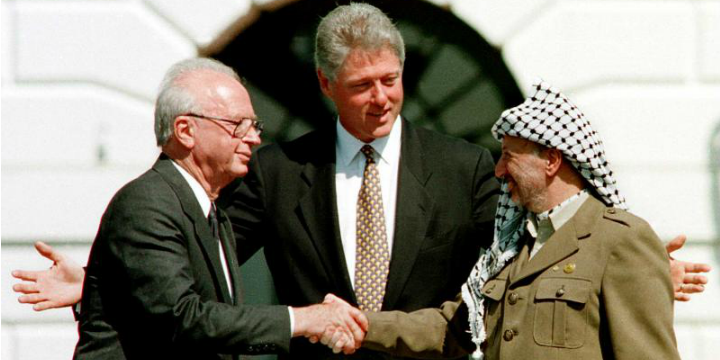
The signing of the Oslo Accords in Washington, DC, Sept. 13, 1993. Photo: Wikimedia Commons.
JNS.org – The number of Gaza residents willing to participate in Hamas’ riots along the border fence is dropping, as seen at last Friday’s protest. Hamas is no longer hiding the fact that the demonstrations are not intended to be quiet marches, but violent attempts to carry out attacks on Israeli soldiers and civilians, damage the Israeli border fence and military equipment, and burn fields and forests.
We can assume that leading up to May 15, on which the Palestinians mark the Nakba (or “Catastrophe”) of their displacement during Israel’s 1948 War of Independence, the border will heat up again. Hamas will encourage Gazans to head out for the “marches of return,” reminding Israel and the world that the Palestinians are still committed to the dream of return, which in essence means the destruction of the State of Israel.
As Hamas prepares for more rounds of violence, since it has nothing to offer the residents of Gaza other than that, the Palestinian Authority (PA) in Ramallah has been keeping mum. This is due in part to internecine Palestinian power struggles — primarily, the fight over who will succeed PA leader Mahmoud Abbas — but also because Abbas and his friends do not want and actually cannot escape the trap that they closed on themselves when they turned up their noses at the Trump administration’s attempts to kick-start the peace process.
The Palestinian nationalist movement is at one of the lowest points in its history. Some, even among the Palestinians, argue that it has come to the end of the road. Its goals — even the smallest ones — are slipping out of its reach. No matter what happens, their fate is once again out of their hands and out of the hands of their leadership, whether that happens to be the PA, which is pinning its hopes on the international community, or Hamas, which is now making its way back to the welcoming embrace of Iran.
The anniversary of Israel’s independence and its achievements over the 70 years of its existence is an excellent opportunity for the Palestinians to spend some time thinking about where they went wrong, and what could extract them from the dead end they have found themselves in.
After 100 years of clashes (dating from the Balfour Declaration), 70 years of conflict (starting with the 1948 War of Independence), and a quarter-century since the Oslo Accords, which were supposed to have given the Palestinians both peace and a land of their own, it looks like they are losing the little they have managed to obtain.
The Palestinian nationalist movement was always a mirror image of Zionism. In other words, it was born out of and in response to the Jewish national movement. This means that the battle against the Zionist idea and the desire to serve as an antithesis to everything that Israel symbolizes were and are a common denominator rather than a defining element of Palestinian identity. This is not enough to sustain a national movement and lead it to success.
The sources of Palestinian weakness have never changed: the lack of a national identity that supersedes the tribe, the clan, or the village, and is nothing more than a rejection of the other (Zionism); the lack of any legitimate, effective leadership that lays out a path and convinces the public to take it; a weak economy; religious radicalization; and, above all, depending on others to rescue the Palestinian people from their distress.
From 1948 to 1967, the Palestinians hung their hopes on the Arab states. For the PA, it’s now the international community, the same vague and amorphous entity whose efficacy we have seen in Syria. For Hamas, hope lies in Iran and Turkey.
This is a challenging reality for Israel, because it means the hope that one day Israel will find a Palestinian partner for either a peace deal or, in the case of Gaza, a truce, is currently a false one.
It’s hard to imagine that the Palestinians in their current situation are capable of compromise at all, much less a compromise acceptable to Israel, which is the stronger side. It also means that, in the future, the ball is in Israel’s court when it comes to its approach towards the Palestinians. Ultimately, it’s doubtful whether the Palestinians wish to or even can take part in the game.
Eyal Zisser is a lecturer in the Middle East History Department at Tel Aviv University.