



Israel to Issue Its Own Report on Gaza Riots, Won’t Collaborate With United Nations Human Rights Council
Error: Contact form not found.

 by Benjamin Kerstein

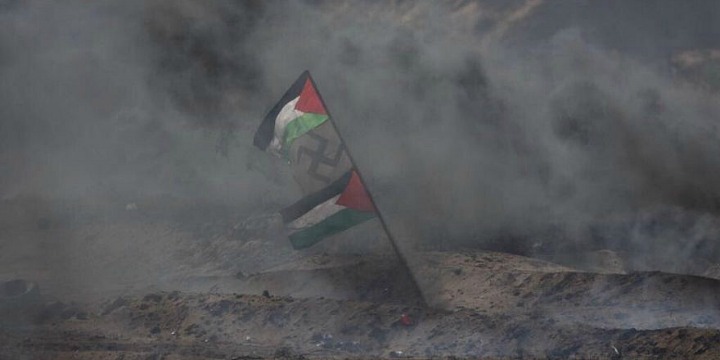
A swastika on display during Gaza border riots in early April. Photo: IDF via Twitter.
Israel will not collaborate with the United Nations Human Rights Council on an investigation into the recent riots on the Gaza border. Instead, it will issue its own report on the events, Hebrew media outlets reported on Sunday.
Around a hundred Palestinians were killed in the riots, most of them terrorists. The events were marked by attempts to breach the border fence, the planting of explosives, and the use of kites equipped with incendiary devices.
The UNHRC recently voted to establish a committee to investigate the riots, with only the US and Australia opposing the idea.
Israel views the UNHRC as wholly biased and therefore unable to conduct a fair investigation. The overwhelming majority of the council’s resolutions are anti-Israel, and the Jewish state is the only country that is the object of a permanent agenda item.
The Israeli Foreign Ministry said of the council, “The results of the investigatory committee are known in advance and are written into the language of the resolution itself. It is clear to everyone that the council’s goal is not a real investigation, but to harm Israel’s right to self-defense and the specific demonization of the Jewish state.”
In response, Israel will issue its own report. According to the Hebrew news site Walla, a top legal official stated, “Previous experience teaches that the best response to the false narrative put forward by the Human Rights Council is to present a direct and professional presentation of the facts for their approval.”
The official noted that Israel has done this in the past and “the reports that Israel published were greatly valued around the world, and contributed to many people having a better understanding of the IDF’s actions and their justification.”
Walla said the report will likely follow the same pattern as previous such documents. It will open with a description of the background to the conflict, then continue with an overview of the military capabilities of the enemy, an outline of the military actions of the IDF, and its adherence to its own regulations and international law. It will end with a description of Israel’s own investigations into the incidents and the conclusions reached both by military and civilian legal bodies.


