







Poland’s History Hangs Heavy; So Does Its Present
Error: Contact form not found.

 by Eric Rozenman

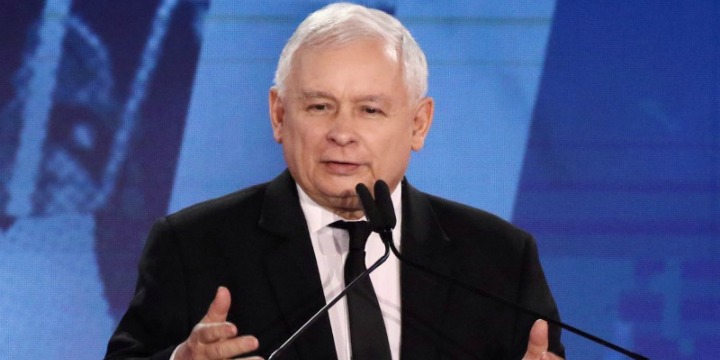
Jaroslaw Kaczynski, leader of the ruling Law and Justice party, delivers a speech during the party convention in Warsaw, Poland, April 14, 2018. Photo: Agencja Gazeta/Slawomir Kaminski via REUTERS.
“The past is never dead. It isn’t even past,” William Faulkner famously wrote. While Faulkner was writing of his native Mississippi, he could have been describing Poland.
The past weighs heavily on Warsaw. It underlies the desire for a permanent US troop presence. It influences a recent government move to oust Supreme Court judges, which pits Poland against the European Union. So does resistance to migration from the Middle East. And the past is unavoidable in the controversy over Polish legislation criminalizing certain speech about the Holocaust.
History lurks behind the headlines.
Prussia, Russia, and Austria partitioned Poland out of existence in the 1790s. It reappeared as an independent state only at the end of World War I. That Poland lasted 20 years, until Nazi Germany and the Soviet Union divided it in 1939. World War II allies crushed Germany, but Moscow — through puppets — repressed Poland until the Soviet empire collapsed in 1989.
Polish history stretches back a millennium, but today’s 38 million Poles live in a new state with fractious politics. The ruling Law and Justice Party (PiS), described as conservative by some, right-wing by others, won 38% of the vote in the 2015 elections. That plurality gave it a parliamentary majority, and allowed it to form the first single-party government since democracy’s return in 1989.
But what PiS does with that majority has been consistently controversial.
Though an independent Ukraine, not Russia, now borders Poland to the east, Russia’s seizure of Crimea and fomenting of war in eastern Ukraine got Poland’s attention. This spring, Poland reportedly offered as much as $2 billion to support a base for a US armored division.
President Donald Trump’s drive to hold NATO members to their pledges to spend at least two percent of gross domestic product on defense doesn’t ruffle Warsaw. Poland, at 1.99% and rising, ranks ahead of other alliance countries such as Italy, Spain, and even Canada and Germany.
Meanwhile, EU representatives decry what they discern as a Polish government threat to rule of law in a Supreme Court maneuver. The Polish high court has more than 100 judges, some of whom began their judicial careers under the communist regime. PiS portrays forced retirement for these judges as house-cleaning; Brussels warns that it could punish Poland for undermining an independent judiciary.
Another sore spot with the EU is what some commentators call the ruling party’s anti-immigration and anti-Islamization platform. In this, says Daniel Pipes, president of the Middle East Forum, PiS shares the concerns of Austria’s Freedom Party and Italy’s League. This irritates Brussels’ Eurocrats, multiculturalists in theory who in practice can’t say how to absorb millions of immigrants from the greater Middle East.
The Polish government also has kept the political pot bubbling with legislation amending an existing law on discussion of the Holocaust. Among other things, the measure barred references to “Polish death camps.” Poles are vehement that places like Auschwitz-Birkenau were “Nazi German concentration camps” in Poland, not Polish murder factories. In them approximately 3.2 million of Poland’s pre-war Jewish population of 3.5 million — which comprised one-tenth of the country’s total inhabitants — were killed. Another three million non-Jewish Poles also died in World War II.
Upon parliamentary modification of the amendment late last month, Polish Prime Minister Mateusz Morawiecki and Israeli Prime Minister Benjamin Netanyahu issued a joint statement. They condemned “cruelty against Jews perpetrated by Poles” during the Holocaust, but also noted “heroic acts of numerous Poles” who risked their lives to save Jews. The statement additionally said the wartime Polish government-in-exile in London and its underground armed forces strove to obstruct the annihilation of Polish Jewry.
But early this month, Yad Vashem, Israel’s Holocaust memorial and research center, criticized the joint declaration. The government-in-exile “did not act resolutely on behalf of Poland’s Jewish citizens” and much of the Polish resistance “not only failed to help Jews, but was also not infrequently actively involved in persecuting them,” it asserted.
There may be no more than 7,000 Polish Jews today — with 100,000 or more of recent Jewish descent. The 800-year history of Polish Jewry, a story of welcome and rejection, sometime prosperity, and recurrent massacres, overshadows the present.
But there are sparks of revival. The most conspicuous is the week-long annual Krakow Jewish Culture Festival. The June event closed as usual with more than 10,000 people crowding the “Shalom on Szeroka Street” Jewish music concert.
The Roman Catholic Church remains a keystone in Polish national identity — unlike Christianity in Great Britain, France, and Germany. Perhaps here lies one factor in EU annoyance with Poland, and in the latter’s good relations with Israel, the Jewish state; as well as with America, in which nearly 40 percent of the public claims to attend church weekly. Call it the new post-national, post-Christian Europe versus the old-new post-Communist one.
Eric Rozenman has served as Washington director of the Committee for Accuracy in Middle East Reporting since 2002. Previously, he worked as executive editor of B’nai B’rith’s International Jewish Monthly and editor of The Washington Jewish Week.
This article was originally published by The Washington Examiner.