



Turkey: New System, Same One-Man Show
Error: Contact form not found.

 by Burak Bekdil

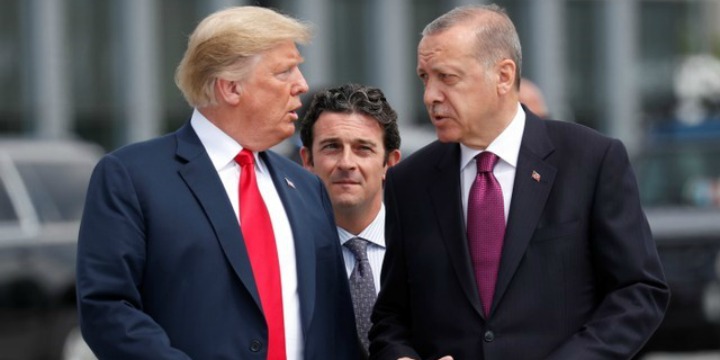
President Donald Trump and Turkish President Tayyip Erdogan talk at the start of a NATO summit, July 11, 2018. Photo: REUTERS/Kevin Lamarque.
President Recep Tayyip Erdoğan, undoubtedly the most popular and divisive leader in modern Turkish history, has already ruled the country longer than Atatürk, the founder of modern secular Turkey. By 2023, when his presidential term expires, Erdoğan will have ruled Turkey for 21 years compared to Atatürk’s 15. It may sound like a joke, but the Turkish president, among other duties, will now have the authority to set pharmaceutical prices and traffic fines for motorists driving without winter tires on snowy roads.
Erdoğan has dominated Turkey for more than 15 years, but to him, this is not enough. After he comfortably won a presidential race on June 24, he quickly transformed Turkey’s parliamentary system into an executive presidential system with almost no checks and balances. He had won that authority in a referendum in April 2017, but his new powers would only take effect after the first presidential election.
The lira further depreciated against major western currencies and the stock market fell rapidly after Erdoğan put his son-in-law, Berat Albayrak, in charge of the treasury and finance. In one of three presidential decrees, it was announced that Erdoğan would personally appoint the Central Bank governor (who, in theory, should remain autonomous), as well as Central Bank deputies and monetary policy committee members.
Erdoğan’s new cabinet consists mostly of newcomers, including four businesspeople: a tour operator in charge of tourism, a college owner as education minister, a businesswoman as trade minister, and a hospital owner as health minister. Most other new ministers are technocrats.
Two key cabinet posts remained unchanged: Foreign Minister Mevlüt Çavuşoğlu and Interior Minister Süleyman Soylu kept their seats. Çavuşoğlu had been acting more as a “Secretary” than a policy-making minister in Erdoğan’s former cabinet, often performing protocol duties and implementing Erdoğan’s policy directives. He will remain a “Secretary” with the title of a minister.
Soylu, on the other hand, is a trusted politician who has waged a hawkish war against Kurdistan Workers’ Party (PKK) militants at home, and against Kurdish militants in both northern Syria and Iraq. Soylu, along with his Gendarmerie Commander, General Arif Çetin, has conducted two military operations against Kurdish targets in northern Syria since 2017, with only a few Turkish casualties. The Turkish army says it has neutralized nearly 5,000 terrorists, mostly in Syria, in this year alone. Soylu’s reappointment shows Erdoğan’s endorsement of his warfare-based Kurdish policy.
Erdoğan has never hidden his appetite for limitless one-man rule. In his election campaign, he pledged a “strong Turkey with strong leadership,” while his main presidential rival, Muharrem Ince, promised a return to the parliamentary system. Erdoğan won 52% of the vote, while Ince won 31%.
Erdoğan, now head of state, government, and the ruling party, will also lead a host of presidential councils that will recommend policy and inspect ministries on science, technology, and innovation, education, the economy, security and foreign policy, the judiciary, culture and the arts, health and food safety, social policies, and local administration.
He will be in charge of national heritage, the military, intelligence, the defense industry, religious affairs, a government-run multi-billion dollar Wealth Fund, the National Security Council, the State Inspection Board, and the Communications Directorate.
But that is not enough. He will inspect and impose flight bans and set rates for vehicle inspections, appoint members of road safety boards, decide on investment incentives, and set the locations of free trade zones (Presidential Decree No. 703).
Furthermore, Erdoğan will have sole authority to appoint the presidents and members of the Religious Affairs Directorate, Higher Education Board, universities, National University Examination Board, state broadcaster TRT, National Intelligence Agency, State Inspection Board, Defense Industry Presidency, Privatization Administration, independent boards and watchdogs, broadcasting authority, Banking Insurance Fund, State Relief Agency, State Revenue Administration, Social Security Institution, Turkish Cooperation and Development Agency, State Statistical Institute, inspection boards of ministries, State Housing Authority, State Patent Agency, Turkish Atomic Energy Agency, regional development agencies, and the state scientific research institute TUBITAK.
In two different votes, the first in April 2017 and the second in June 2018, the Turks chose to radically change the regime that their founding father Atatürk established in 1923. They have chosen a strong executive president and grotesque one-man rule over a parliamentary system with checks and balances. Ironically, they democratically voted in favor of an undemocratic regime.
The vote on June 24 made Erdoğan’s de facto executive presidency into a de jure executive presidency. Erdoğan is happy, as are his loyalists. One question remains unanswered, however. What will happen after Erdoğan? Who will rule Turkey, and how, with such an excess of power in his hands? Erdoğan himself has no answer to that.
Burak Bekdil is an Ankara-based columnist. He regularly writes for the Gatestone Institute and Defense News, and is a fellow at the Middle East Forum. He is also a founder of and associate editor at the Ankara-based think tank Sigma. BESA Center Perspectives Papers, such as this one, are published through the generosity of the Greg Rosshandler Family.