







The End of the Syrian War Will Lead to Risks for Israel and the US
Error: Contact form not found.

 by Eyal Zisser / Israel Hayom / JNS.org

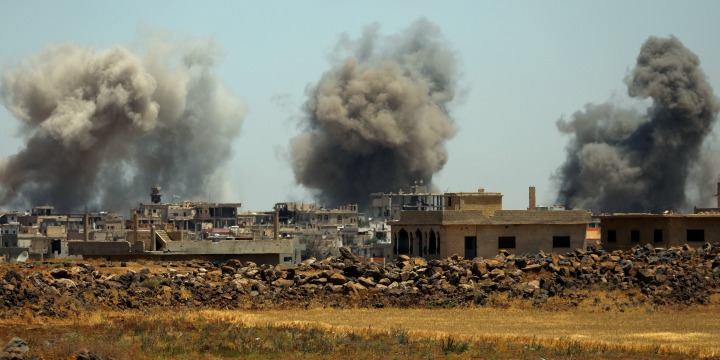
Smoke rises from al-Harak town, as seen from Deraa countryside, Syria June 25, 2018. Photo: REUTERS/Alaa al-Faqir.
JNS.org – Once again, Israel’s northern front is becoming tense. The Russians continue to fight on behalf of Syrian President Bashar al-Assad’s regime. The Iranians are also stoking the fire, with Iran’s defense minister signing a defense cooperation pact and promising to help rehabilitate the Syrian military.
Assad is now preparing for an assault. In the coming days, his forces, with the help of Iran and Russia, will begin the final campaign to conquer the last remaining rebel stronghold in Idlib, thereby possibly ending the seven-year uprising against the regime.
In an effort to justify the likely war crimes that the regime will commit, Russian Foreign Minister Sergey Lavrov said that Idlib is a festering abscess, thus foreshadowing the brutal approach in the fighting.
But it seems that no one in the West actually cares, particularly in Washington. Although the White House has warned Assad — lest he be tempted to use chemical weapons once again — Donald Trump has already announced that he will leave Syria because he believes that with the Islamic State wiped out, there is nothing left to do there.
But Assad’s emerging victory doesn’t herald the end of the conflict. A new conflict will now begin, partly between Russia and Iran over the spoils of the war and who will keep Syria in its economic and political sphere of influence.
The US is trying to figure out how it can prevent the Islamic State from rebounding, and it is convinced that Damascus is key. That is why over the past several weeks, a growing number of European and American delegations have been arriving in the Syrian capital.
The Europeans want to find a mechanism that would repatriate the Syrian refugees from Europe; the Americans want to ensure Iranian forces leave the country. But neither goal is likely to be met. Assad has no interest in having the refugees return, nor does he want the Iranians out.
For the time being, Assad and his allies have good reason to celebrate, with other players paying the price. The miserable Syrian populace will suffer the most. Some 500,000 have already been killed, and as many as 10 million have been displaced.
The Kurds, who have helped the US in its campaign against the Islamic State, are soon going to find out that they have an expiration date. Once the US decides they are no longer useful, it will throw them under the bus, just as they did to the Kurds in Iraq.
Israel might also have to pay a price because of the West’s desire to reconcile with Assad and help him rebuild Syria, with the wishful thinking that this will somehow drive the Iranians out of the country. The fate of the Golan Heights might also come up, as Israel struggles to maintain its freedom of operations in Syria.
Seven years of war in Syria created the impression that the dispute over the Golan Heights was effectively over because no one expected Assad’s regime to remain intact. But even though Assad survived, we can take comfort in the fact that, like his father, he will eventually get cold feet when it comes to a possible peace process with Israel. This means that he will guard the status quo of “no war, no peace.” Syrian rulers have long preferred this situation over a peace process that could generate problems within Syria and between Syria and Iran.
Eyal Zisser is a lecturer in the Middle East History Department at Tel Aviv University.