





US Bible Museum Says Five Dead Sea Scrolls Fragments Fake
Error: Contact form not found.

 by Reuters and Algemeiner Staff

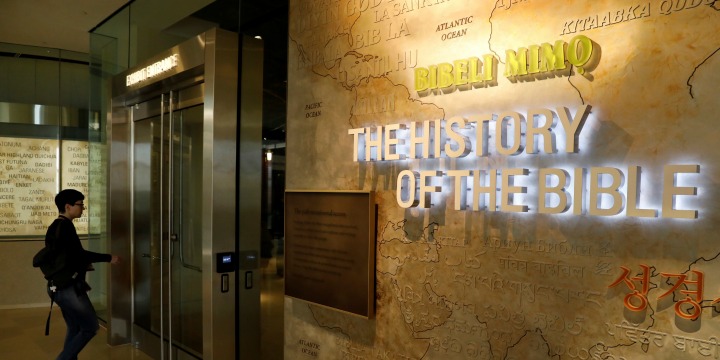
A visitor enters an exhibit room during a preview at the Museum of the Bible in Washington, DC, Nov. 14, 2017. Photo: Reuters / Kevin Lamarque / File.
The Museum of the Bible in Washington on Monday said five of its artifacts thought to be part of the Dead Sea Scrolls were fake and would not be displayed anymore.
German-based researchers tested the fragments and found five “show characteristics inconsistent with ancient origin and therefore will no longer be displayed,” the museum said in a statement.
Academics have long questioned the authenticity of Dead Sea Scroll fragments sold by antiquities dealers. The museum established by the Green family of Oklahoma, who own US craft-store chain Hobby Lobby, funded research over the past two years into whether its 16 Dead Sea Scroll fragments were genuine.
“Though we had hoped the testing would render different results, this is an opportunity to educate the public on the importance of verifying the authenticity of rare biblical artifacts,” Jeffrey Kloha, chief curatorial officer for the Museum of the Bible, said in the statement.
Scholars and media reports raised questions about the museum’s Dead Sea Scroll fragments last year in the run up to the Green family’s November opening of the $500 million museum.
The Dead Sea Scrolls, composed of hundreds of manuscripts and thousands of fragments of ancient Jewish religious texts, were discovered in the West Bank by Bedouin shepherds in the 1940s. The nearly 2,000-year-old scrolls gave religious scholars a new trove of information on the Hebrew Bible.
Kipp Davis, an expert on the Dead Sea Scrolls at Trinity Western University in Canada, was one of several academics who studied the Museum of the Bible’s scroll fragments, prompting the museum to send five for testing.
“My studies to date have managed to confirm upon a preponderance of different streams of evidence the high probability that at least seven fragments in the museum’s Dead Sea Scrolls collection are modern forgeries, but conclusions on the status of the remaining fragments are still forthcoming,” Davis said in the statement.
The museum sent the five fragments to Germany’s BAM institute for analysis of their ink.
Forgers typically write on top of ancient scraps of parchment or leather, making fragments appear authentic until their ink is tested.