


Iran Wants to Expand Missile Range Despite US Ire
Error: Contact form not found.

 by Reuters and Algemeiner Staff

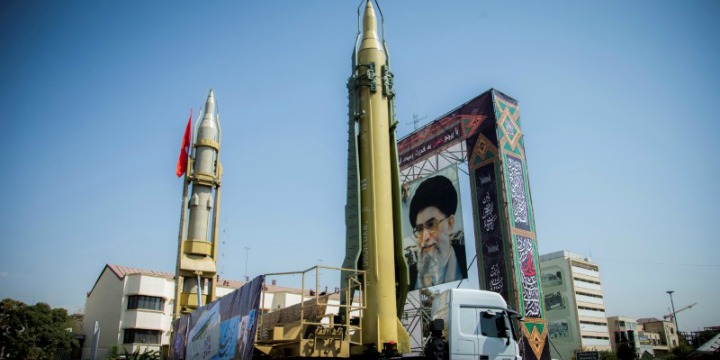
A display featuring missiles and a portrait of Iranian Ayatollah Ali Khamenei is seen at Baharestan Square in Tehran, Sept. 27, 2017. Photo: Nazanin Tabatabaee Yazdi / TIMA via Reuters.
Iran wants to increase its missiles’ range, a senior military official was quoted as saying on Tuesday, a move that would irk the United States which views Tehran’s weapons program as a regional security threat.
US President Donald Trump pulled out of an international nuclear agreement in May and reimposed sanctions on the Islamic Republic, criticizing the deal for not including curbs on Iran’s development of ballistic missiles.
“One of our most important programs is increasing the range of missiles and ammunition,” Iranian air force head, Brigadier General Aziz Nasirzadeh, said, according to the semi-official Fars news agency.
“We don’t see any limitations for ourselves in this field.”
Iran’s military has cited 2,000 kilometers (1,240 miles) as the current missile range, and said US bases in Afghanistan, the United Arab Emirates and Qatar, plus US aircraft carriers in the Gulf, were within range.
Nasirzadeh did not give details on how far Iran would like to increase that range, according to the Fars report.
Tehran insists its missile program is purely defensive but has threatened to disrupt oil shipments through the Strait of Hormuz in the Gulf, if Washington tries to strangle its exports.
At the weekend, US Secretary of State Mike Pompeo condemned what he described as Iran’s testing of a medium-range ballistic missile capable of carrying multiple warheads as a violation of the agreement on Tehran’s nuclear program.
Iran has repeatedly said its missile program is not up for negotiation.