







New Snags Over Hezbollah-Allied Sunni Group Hold Up Formation of Lebanon Unity Government
Error: Contact form not found.

 by Reuters and Algemeiner Staff

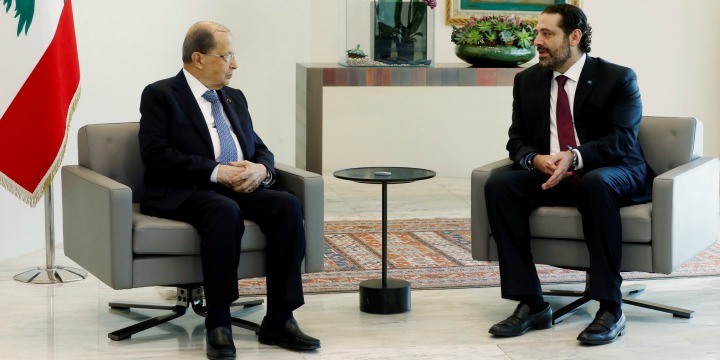
Lebanon’s President Michel Aoun meets with Lebanese Prime Minister-designate Saad al-Hariri at the presidential palace in Baabda, Lebanon June 22, 2018. Photo: REUTERS/Mohamed Azakir/File Photo.
Efforts to finalize a deal on a Lebanese national unity government hit new snags on Saturday, postponing its formation, a senior official closely involved in the efforts said.
More than seven months since its last general election, Lebanon, heavily indebted and suffering from low economic growth, is in dire need of an administration to enact long-stalled reforms and put public debt on a sustainable footing.
A deal on a new government led by Prime Minister-designate Saad al-Hariri looked close earlier this week when a mediation effort made headway towards resolving the last big problem, which surrounded Sunni Muslim representation.
Hariri, Lebanon’s leading Sunni politician, said on Friday he hoped to finalize the cabinet later that day. The cabinet seats must be parceled out among rival groups according to a finely balanced sectarian system.
“A number of obstacles have appeared in the last hours that led to delaying the government. The obstacles include the problem of Sunni representation and the problem of portfolio distribution,” the official said.
The official did not give an estimate as to when the problems would be resolved.
More contacts are expected on Sunday.
The dispute over Sunni representation emerged as a group of Sunni MPs allied to the Shi’ite group Hezbollah said they must be allocated a seat in the cabinet to reflect their election gains and Hariri resisted their demand.
Under the compromise solution, the six pro-Hezbollah Sunnis agreed to be represented in the cabinet by another figure acceptable to them, with each of the six submitting a name from which President Michel Aoun would pick one.
But on Saturday, the pro-Hezbollah Sunni MPs withdrew their support for the Sunni candidate picked by Aoun – Jawad Adra – because he “did not consider himself an exclusive representative” of the six Sunni MPs.
Fresh disputes have also arisen over precisely which portfolios should go to which factions. The portfolios in question are seen as of secondary significance, the official said, with the most powerful ministries already allocated.
The May 6 national election, Lebanon’s first in nine years, produced a parliament tilted in favor of the heavily armed, Iran-backed Shi’ite Muslim group Hezbollah, which together with its political allies won more than 70 of the 128 seats.
Hariri, who enjoys Western backing, lost more than one third of his lawmakers, though he remained Lebanon’s biggest Sunni Muslim leader and as such was nominated again as prime minister.