







Losing Faith in the PLO
Error: Contact form not found.

 by Eyal Zisser / Israel Hayom / JNS.org

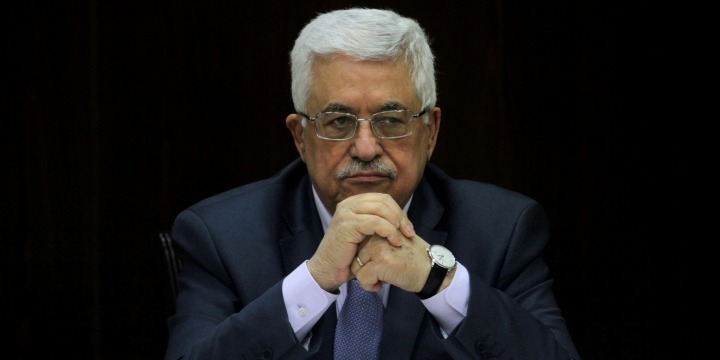
Palestinian Authority President Mahmoud Abbas heads a Palestinian cabinet meeting in the West Bank city of Ramallah, July 28, 2013. Photo: Reuters / Issam Rimawi / Pool / File.
JNS.org – The Palestinian Authority marked 54 years since the Fatah Party’s establishment this week. Fatah, of course, controls the PA and has led the Palestinian national movement for the past 50 years. Although the movement started in the 1950s, its founders, among them late PLO leader Yasser Arafat, chose to set the day of its official establishment as Jan. 1, 1965, the day on which its members carried out their first ever terrorist attack on Israel.
But the modest festivities were clouded by Hamas’s refusal to allow members of the Palestine Liberation Organization into the Gaza Strip to mark the occasion. Hamas spokesmen noted that when the organization celebrated 31 years since its establishment less than a month earlier, Palestinian security forces in Judea and Samaria dispersed rallies organized by Hamas supporters to celebrate the event.
It was just one year ago that the PA and Hamas signed a reconciliation deal that was not worth the paper it was written on. The distance and the difference between the Gaza Strip and Ramallah have since grown, and the hostility between them has reached new heights following the PA’s decision to embark on an overt campaign against the Hamas regime in Gaza, forcing the it to ask for assistance from Israel and Qatar to save the enclave from the financial crisis brought upon it by PA leader Mahmoud Abbas. No wonder Abbas dedicated significant portions of his speech to mark the anniversary of Fatah’s founding to attacking Hamas, alongside the usual condemnations of the Israeli government and the US administration, of course.
But Abbas and his fellow PA leaders, as well as his rivals in Hamas, have left the Palestinian street indifferent. It seems many Palestinians no longer see the PA or Hamas as capable of managing their affairs, let alone leading them to the realization of their goals.
This may have something to do with the fact that Abbas, his health poor and widely perceived as being disconnected from reality, recently celebrated his 83rd birthday. His fellow PA leaders are not any younger. They are members of the old guard that remain glued to their chairs and refuse to admit their mistakes and recognize that the reality in the region, including for Palestinians, has substantially changed in the past five decades. Even imprisoned arch-terrorist Marwan Barghouti, for years considered “the next big thing” among Palestinians were Israel to only agree to let him out of prison, is set to mark his 60th birthday behind bars in June. He isn’t exactly a member of the younger generation capable of bringing about the change the Palestinian public so badly needs.
But it appears the problem does not only lie in the identity and age of the leader, but the path. The path of the PA under the leadership of the PLO and Fatah, as well as that of the Hamas terrorist organization has led the Palestinians to a dead end.
The Palestinian national movement has come a long way in the last 50 years. In 1974, the same year the Arab states recognized the PLO as the sole representative of the Palestinian people, Arafat was invited to address the UN General Assembly. Later, in the 1990s, many Israelis saw him as a legitimate leader and a partner for peace.
But in the last decade, and in fact even earlier, the Palestinians lost everything they had achieved thus far. Israel lost its faith in the Palestinian leadership and its supposed desire for peace as a result of the Second Intifada of the early 2000s. In recent years, the Palestinians have also lost the support of the wider world, including the Arab nations. No one has any interest in the Palestinians, and absolutely no one is willing to fight their wars for them.
But now it appears the Palestinian public is beginning to lose its faith in the Palestinian leadership and with it the Palestinian national idea. So, for example, Arab Israelis in eastern Jerusalem choose to be Israeli, whether by carrying Israeli residency cards; taking Israeli, not Palestinian, high school matriculation exams; or getting their degrees at Israeli institutions of higher education that will ensure them a better future. Many Palestinians are likely to act likewise if they are allowed. Palestinian society is beginning to splinter; Israel would be wise to prepare for that in advance.
Eyal Zisser is a lecturer in the Middle East History Department at Tel Aviv University.