

The ‘Apartheid Road’ That Isn’t
Error: Contact form not found.

 by Stephen M. Flatow / JNS.org

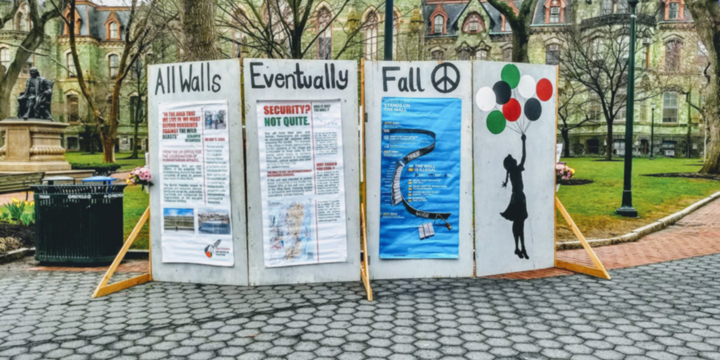
A display erected by Penn Students for Justice in Palestine during its “Israeli Apartheid Week” campaign. Photo: Penn SJP.
JNS.org – “Segregated Highway Opens in West Bank,” The Washington Post headline blared recently. “Israel Opens ‘Apartheid Road’ in Occupied West Bank,” announced Al Jazeera.
Apartheid? Segregation? Not even close. Like so much of what pretends to be news reporting about Israel these days, this latest “Israeli racism” allegation is just another cheap attempt to smear the Jewish state.
This newest prop in the Palestinian Arab propaganda war against Israel is a highway called Route 4370, northeast of Jerusalem. There is a physical barrier down the middle of the highway. Israeli traffic goes on one side, Palestinian Arab traffic on the other.
Is that apartheid? Of course not. Apartheid means separating people on the basis of their race. Jews, of course, are not a race; and neither are Arabs. On both sides of the divider, there will be drivers of various hues. Dark-skinned Ethiopian Jews alongside light-skinned Russian Jews. Dark-skinned Arabs alongside light-skinned Arabs.
How about religion? Is the traffic divided according to religion? Not at all. On the Israeli side, Israeli Jews, Muslims, and Christians are all permitted to drive. On the Arab side, Palestinian Muslims and Palestinian Christians drive.
How about ethnicity? Is it divided according to ethnicity? Of course not. Israeli Jews and Israeli Arabs are both driving on one side. Palestinians who are of Egyptian origin, Palestinians of Syrian origin, and Palestinians of Lebanese origin are all driving on their side.
So it’s not “apartheid.” And it’s not racial, religious, or ethnic “segregation.”
What is it, then? Simple. It’s a division based on citizenship.
Israeli citizens — of all races, religions, and ethnicities — are permitted to drive on one side. Non-citizens — of all races, religions, and ethnicities — are allowed to drive on the other.
And for good reason. Because on Israeli roads in Judea-Samaria where non-citizens have been permitted access, there have been numerous drive-by shootings by Palestinian Arab non-citizens. There have also been stonings in which Palestinian Arab non-citizens threw rocks from cars because their deadliness had been greatly increased by the speed of the automobiles. That’s how American citizens Asher Palmer and his infant son Yonatan were murdered in 2011.
The presumption in Israel is that those who are citizens of Israel — whether Jew, Muslim, or Christian — can be generally trusted to be loyal to the state and not likely to engage in terrorism. Obviously, there are exceptions. But by and large that presumption is accurate.
By contrast, Palestinian Arab non-citizens are engaged in anti-Jewish violence at an alarmingly high rate. There is no reason to give them the benefit of the doubt and assume that they will be kind or even non-violent.
More than that, the Palestinian Authority has, for the past 25 years, fed its citizens a daily diet of anti-Jewish hatred and glorification of anti-Jewish violence in their schools, television, radio, newspapers, and all other segments of their culture. It is a society drenched in antisemitism. Meaning, it is the one society most likely to produce hostile and violent people. Why in the world would Israel expose its citizens to such dangers on its roads?
Every country in the world has different rules for citizens and non-citizens. That’s not apartheid. It’s not segregation. It’s common-sense rule of law. What would be the point of even having citizenship if non-citizens were governed by the same regulations?
The fact that Israel spends millions of shekels building roads for Palestinian Arabs is a remarkable act of unreciprocated generosity. The international community should be heaping praise on the Israelis for kindness, not harassing the Jewish state with lies about “apartheid.” But I guess we’ve all gotten used to that kind of treatment by now.
Stephen M. Flatow, an attorney in New Jersey, is the father of Alisa Flatow, who was murdered in an Iranian-sponsored Palestinian terrorist attack in 1995. His book A Father’s Story: My Fight for Justice Against Iranian Terror is available on Amazon.