




The Iranian Threat to Israel Is Real
Error: Contact form not found.

 by Michael Harel

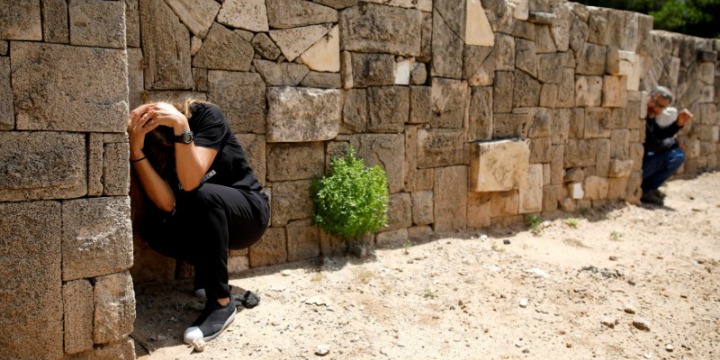
Israelis take cover as a siren sounds warning of incoming rockets from Gaza, in the southern city of Ashkelon, May 5, 2019. Photo: Reuters / Amir Cohen.
Seven hundred rockets fell on Israel on May 6, initiating the greatest escalation of violence between Israel and Gaza in recent times, and leaving four innocent Israeli civilians dead and more than 100 injured. Life in Israel was brought to a dramatic halt as shrill warning sirens repeatedly blasted throughout the long day, instilling nightmarish panic.
The rocket attacks were largely initiated by the Palestinian Islamic Jihad (PIJ) — a terrorist organization funded by Iran. But why now? According to former Israeli national security adviser Yaakov Amidror, “The answer is again and again and again – Iran.”
According to Amidror, Iran’s agenda was for Israel to be “busy focusing on Gaza and not have enough energy to deal with the building up of an independent war machine in Syria.”
Many critics of Israel claim that Israel’s military actions in Gaza and the West Bank are not taken for security reasons, but rather to oppress the Palestinian people. However, the Mideast conflict is not so simple, and the Iranian threat is just another example of its complexities. For those seeking a peaceful resolution to the Israeli-Palestinian conflict, it is important to understand the threat posed by an Iranian regime hell-bent on Israel’s destruction.
Iran’s “progressive” president, Hassan Rouhani, recently proclaimed that Israel is a “cancerous tumor” that must be removed. But Iran’s threats are not only talk. It has developed a strong military, ranked the 13th most powerful in the world by the defense site Global Firepower, ahead of Israel at 16.
Additionally, Iran could be on a path to developing nuclear weapons, with Rouhani announcing on May 8 that Iran would start actively stockpiling extra low-enriched uranium and heavy water. In addition, Iran has extended its presence in the region via multiple proxies, including Hezbollah in Lebanon, which has over 150,000 rockets pointed towards Israel, as well as growing militias in Syria and Iraq, the Houthis in Yemen, and terror groups in Gaza.
In the event of an all-out war, Iran — with a population of 80 million — could potentially mobilize millions of soldiers, which Israel could not match on its own. Therefore, Israelis are very cognizant of the need to prevent Iran — and Iranian weapons — from infiltrating the West Bank as, they have in Gaza.
Furthermore, Israel cannot count on world support, as Iran and its proxies do not face even remotely close to the condemnation that Israel receives on the world stage. Notably, in December 2018, a UN resolution that would have condemned Hamas and PIJ for, among other things, “repeatedly firing rockets into Israel” failed to pass. Yet, in 2014, 2016, and 2017, 87, 77, and 78 percent (respectively) of resolutions in the UN General Assembly were directed against Israel.
When Israel left Gaza and Lebanon, Iran helped fill the vacuum and empowered proxies there that share its mission to destroy the Jewish state. What would stop the same from happening in the West Bank should a terrorist regime gain power there?
As Maya Angelou once wrote, “When someone shows you who they are, believe them the first time.” When a regime takes repeated steps to threaten the Jewish state and is met with silence from the international community, Israel is left alone to defend itself.