




Bahrain Conference Reveals ‘Palestinian Authority Has No Interest in Peace’
Error: Contact form not found.

 by JNS.org

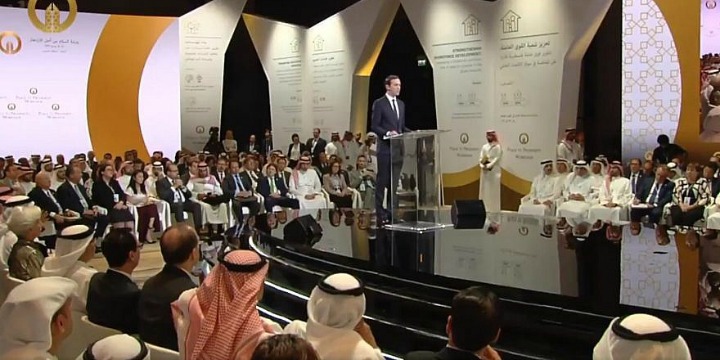
Jared Kushner, senior adviser to US President Donald Trump, addresses the Bahrain “Peace to Prosperity” summit in Manama, Bahrain. Photo: Screenshot.
JNS.org – Despite bringing together a historic number of Arab states and prominent world leaders, the Bahrain economic conference, which seeks to be the first step in the Trump administration’s efforts to bring peace between the Israelis and Palestinians, has been buffeted and vilified, especially by the Palestinians, who called the Trump plan “dead on arrival” and have boycotted the summit.
Senior adviser to and son-in-law of US President Donald Trump Jared Kushner, who spearheaded the initiative, opened the two-day summit on Tuesday by calling it the “opportunity of the century” that the Palestinians should seize upon.
“My direct message to the Palestinian people is that despite what those who have let you down in the past say, President Trump and America have not given up on you,” he said.
Given the decades of failures to achieve peace, the Trump administration has taken a different approach with the Bahrain summit, one that broaches the Palestinian economy before tackling the political aspects of the Arab-Israeli conflict.
However, with so much controversy and seemingly intractable issues, many have questioned if the business-minded Bahrain workshop can accomplish anything at all.
But some are already seeing achievements. Eugene Kontorovich, director of International Law at the Jerusalem-based Kohelet Policy Forum and who has extensively briefed senior officials in the Trump administration on the Arab-Israeli conflict, told JNS: “The Bahrain Economic conference has already succeeded in one major way; it has revealed that the Palestinian Authority has no interest in peace, and no ability to make concessions.”
He added that “a regime that refuses to attend a purely economic conference endorsed by its major Arab allies is one that is simply trying to deepen the suffering of its own people to weaponize against Israel.”
Ahead of the workshop, the Trump administration released a 40-page document on Saturday detailing a $50 billion, 10-year investment plan for the Palestinian Authority, Jordan, Egypt and Lebanon.
The workshop currently taking place in Bahrain has come under heavy attack by the Palestinians, but also from their supporters, especially in Europe.
In a Foreign Policy article titled “Economic Band-Aids Won’t Bring Peace to the Middle East,” Muriel Asseburg of the German Institute for International and Security Affairs, and Hugh Lovatt of the European Council on Foreign Relations, believe that “European leaders should not lend support to a Trump administration plan that dangles economic carrots to Palestinians while entrenching the Israeli occupation.”
Furthermore, they wrote that the initiative “has faced strong resistance from Palestinians who doubt US intentions.”
Efraim Inbar, president of the Jerusalem Institute for Strategy and Security, dismissed their approach, telling JNS that “the European opposition to the Trump peace plan is rooted in anti-American sentiments and a sick blindness to a Palestinian authoritarian regime plagued by corruption and disregard for human rights. Their obsession with the Palestinian issue also reflects an old European disease: antisemitism.”
Inbar agreed with Konotorovich, saying, “The Bahrain workshop is intended to improve the Palestinian economy that is beleaguered by corruption, ineptitude and a bloated bureaucracy. Unfortunately, the Palestinian leadership refuses to cooperate with the US’ generous approach.”
He noted that the Palestinians have once again “forfeited another opportunity to improve their lot and build peace bottom-up.”
Is time running out for the Palestinians?
In his remarks, Kushner made it clear that despite the economic focus in Bahrain, it is still not a substitute for a political solution to the conflict.
“To be clear, economic growth and prosperity for the Palestinian people are not possible without an enduring and fair political solution to the conflict—one that guarantees Israel’s security and respects the dignity of the Palestinian people,” said Kushner.
But Inbar warned that time may be running out for the Palestinians as international support “has been halved since the 1990s” and will continue to dwindle “as long as the Palestinians misbehave.”
He added that the impending economic crisis in the Palestinian territories “is viewed by its leadership as leverage to get more money. This is sickening.”
To some, it may even appear that this workshop was meant to prove once and for all that the Palestinians are not interested in any effort to achieve peace.
Kontorovich suggested that “going forward, the US will likely realize that Israel must take unilateral actions to protect its interests while improving the lives of Palestinians, and will support such steps.”


