








Iran Says Meeting With Parties to Nuclear Deal ‘Constructive’
Error: Contact form not found.

 by Reuters and Algemeiner Staff

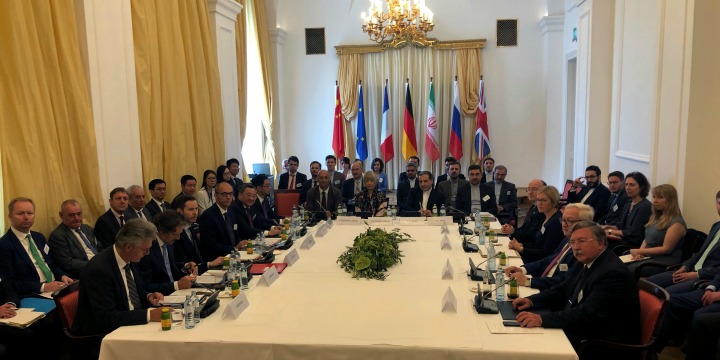
Iran’s top nuclear negotiator Abbas Araqchi and EEAS Secretary-General Helga Schmid attend a meeting of the JCPOA Joint Commission in Vienna, Austria, July 28, 2019. Photo: Reuters / Kirsti Knolle.
An emergency meeting with parties to Iran‘s 2015 nuclear deal was constructive but there are unresolved issues and Tehran will continue to reduce its nuclear commitments if Europeans fail to salvage the pact, Iranian official Abbas Araqchi said on Sunday.
“The atmosphere was constructive. Discussions were good. I cannot say that we resolved everything, I can say there are lots of commitments,” Araqchi, the senior Iranian nuclear negotiator, told reporters after the meeting in Vienna.
Parties to the agreement — Britain, Germany and France plus Russia and China — met Iranian officials for talks called in response to an escalation in tensions between Iran and the West that included confrontations at sea and Tehran’s breaches of the nuclear accord.
“As we have said, we will continue to reduce our commitments to the deal until Europeans secure Iran‘s interests under the deal,” Araqchi said.
The parties have been trying to salvage the pact since the United States withdrew from it in May 2018 and re-imposed and toughened sanctions on Iran, crippling an already weak economy.
The Europeans say further breaches of the agreement by Iran would escalate confrontation at a time when Tehran and Washington are at risk of a miscalculation that could lead to war.
However, their efforts to protect trade with Iran against the US sanctions have yielded nothing concrete so far. Earlier this month, Tehran followed through on its threat to increase its nuclear activities in breach of the agreement.
Iran has said it will withdrew from the pact unless the Europeans find ways to shield its economy from the US sanctions.
“All our steps taken so far are reversible if other parties to the deal fulfill their commitments,” an Iranian diplomat told Reuters ahead of the meeting.
In response to the sanctions, Iran said in May it would decrease its commitments under the nuclear pact. Under the deal, most international sanctions against Tehran were lifted in 2016, in exchange for limitations on its nuclear work.
So far, Iran has breached the limit of its enriched uranium stockpile as well as enriching uranium beyond a 3.67% purity limit set by its deal with major powers, defying a warning by Europeans to stick to the deal despite U.S. sanctions.
The UN nuclear watchdog, policing the deal, has confirmed the measures announced by Tehran.
Sanctions
Fu Cong, director general of the Department of Arms Control of the Chinese Foreign Ministry, who lead the Chinese delegation, said: “All sides have expressed their commitment to safeguard the JCPOA (nuclear deal) and to continue to implement the JCPOA in a balanced manner.
“All sides have expressed their strong opposition against the U.S. unilateral imposition of sanctions.”
The meeting came after Iran’s elite Revolutionary Guards seized a British-flagged oil tanker on July 19, two weeks after British forces captured an Iranian oil tanker near Gibraltar which it said was violating sanctions on Syria.
Araqchi said Britain’s seizure of the Iranian tanker was a violation of the nuclear pact.
“The countries who are part of (the nuclear deal) shouldn’t create obstacles for the export of Iranian oil,” Araqchi said.
Britain has called for a European-led naval mission to ensure safe shipping through the Strait of Hormuz, a vital international oil shipping route. An Iranian government spokesman said on Sunday such a mission would send a “hostile message.”
Britain said on Sunday Royal Navy destroyer HMS Duncan had arrived in the Gulf to join a British frigate escorting British-flagged ships through the Strait.
The seizure of the British tanker in the world’s most important waterway for the oil trade has deepened a crisis between Iran and the West. Iranian President Hassan Rouhani said Britain’s seizure of the Iranian oil tanker was illegal and would be detrimental for Britain.
After meeting Iranian officials in Tehran, Oman’s Foreign Minister Yousuf bin Alawi bin Abdullah said all parties should maintain contact to avoid more incidents in the Strait.
Iran has threatened to disrupt oil shipments through the waterway if the United States tries to strangle its economy with sanctions on its vital oil exports.
Several oil tankers were attacked in waters near Iran’s southern coast in May and June, for which the United States blamed Iran. Tehran denied any involvement.
Iran in June shot down a US military surveillance drone in the Gulf, which Tehran said had violated its air space. Washington said the drone was in international skies.


