



Yiddish and Other Languages
Error: Contact form not found.

 by Paul Socken

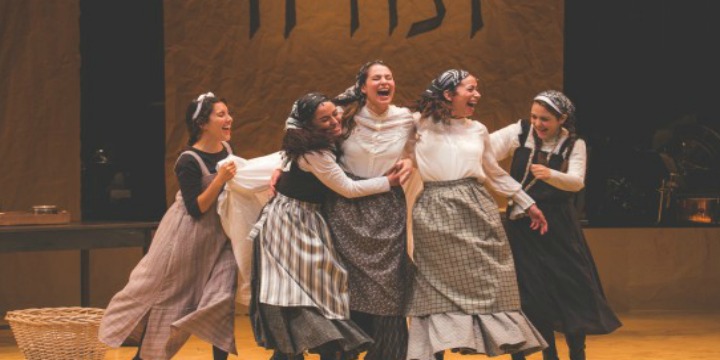
A production photo from the Yiddish-language production of Fiddler on the Roof. Photo: Victor Nechay / ProperPix.
I speak French with my head and Yiddish with my heart.
I learned French in school and made it my field of study and my profession. I know it well enough to call myself functionally bilingual, but it is not my native language. My relationship with French is profound, professional, and cerebral.
I learned Yiddish at my grandmother’s knee. My father and mother did not speak Yiddish with me, but my grandmother knew only Yiddish. I speak it now, but can barely read it. It is a spoken language for me. My relationship with Yiddish is emotional, cultural, and personal.
When I speak Yiddish, I connect with a world I know in a distant way from all I’ve heard and read: eastern European Jewry. It is embodied in the people I know who got out of Europe before the war, like my grandmother, and those who did not, but survived. It’s earthy, practical, hardscrabble, tragic yet witty, funny and profound. I laugh and cry in Yiddish more intensely than in other parts of my linguistic self.
English is my native language. Like everyone else, I speak my native language automatically. The words tumble out. As an academic, I had to learn that even one’s native language needs to be reflected on and carefully cultivated: Slow down and think about what you’re saying or writing. My relationship with English is natural and constantly evolving.
When you have only one language, you have nothing to compare with. When you have more than one, you are constantly bouncing one off the other: “How do they say that in French?” “Do they have an equivalent expression in English?” You are aware of language, its expressiveness, its complexity, and its richness.
Each language is a world, the portal to a culture. Language is born of culture. Using that language gives access to the ideas and experiences of that society. Here is what Isaac Bashevis Singer said in his Nobel Prize address: “The Yiddish mentality is not haughty. It does not take victory for granted. It does not demand and command, but it muddles through, sneaks by, smuggles itself amidst the powers of destruction, knowing somewhere that God’s plan for Creation is still at the very beginning. In a figurative way, Yiddish is the wise and humble language of us all, the idiom of frightened and hopeful humanity.” The great writer presents language as if it were a person. Yiddish, for him, incorporates all Jews; indeed, all humanity.
So, the question is: Am I the same person when I speak Yiddish as I am when I speak French or English? When I immerse myself in a Yiddish conversation with a Yiddish speaker from pre-war Europe, I enter his world, understand his experiences and feelings, share his emotions and reality. When I am in his world, am I not shaped by the experience? When I return to my English self, am I not changed by what I’ve learned?
People with more than one language are not more than one person but, to paraphrase the American poet Walt Whitman, they contain multitudes. Their perspective is broader, their understanding deeper and their experience enriched.
Because cultures vary, they have different ways of seeing the world. They develop sayings and expressions that other languages do not. These words and proverbs often do not have equivalents in other languages.
“L’esprit de l’escalier” in French, literally “the wit of the staircase,” is the clever response to someone that you think of only when you are halfway down the staircase leaving his building. In German, “schadenfreude” is the pleasure someone takes in the misfortune of another. To express the fact that reconciliation is always possible, Yiddish says, “Mountains cannot meet, but a person can” (“A berg mit a berg kennen zikh nit tsuzamen kumen, ober a mentsh mit a mensh kennen“).
All creatures communicate, but only humans have language. We can use it to expand our horizons, share and learn, express our deepest thoughts and feelings. A close friend wrote that a language we don’t know is like a photo within us that was never developed.
As the saying goes, “One language sets you in the corridor of life; other languages open every door along the way.”
Dr. Paul Socken is Distinguished Professor Emeritus and founder of the Jewish Studies program at the University of Waterloo.


