





The Unbearable Cost of a Unity Government
Error: Contact form not found.

 by Gidon Ben-Zvi

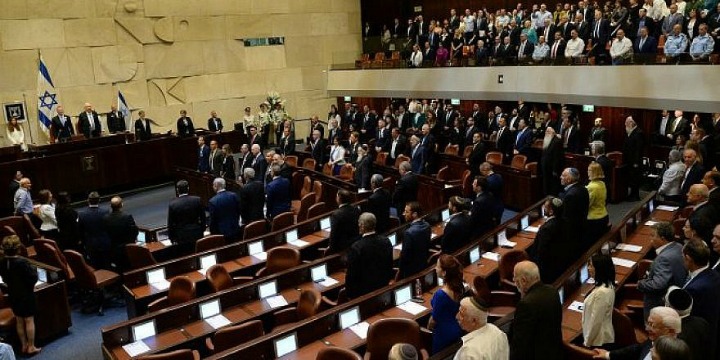
Israeli lawmakers stand during the inauguration of the 21st Knesset. Photo: Haim Zah / GPO.
Ever since Israel’s snap election drew to a close last week, the country’s chattering class has ginned up its campaign to convince Israelis that what they really want is a national unity government. To drive home their point, pundits, commentators, and other members of the country’s intelligentsia have drawn parallels between Israel circa 1984 and today.
This is a false equivalence. When Likud leader Yitzhak Shamir and Labor’s Shimon Peres agreed to share power, the Israeli economy was teetering on the verge of collapse, with inflation running rampant. Israel was also a country at war in 1984 — the first Lebanon war.
Fast forward to the here and now. Israel’s economy and security are relatively stable and have been that way for some time. Despite regular skirmishes with Hamas in Gaza and Hezbollah in Lebanon, the Israel Defense Forces aren’t waging a ground war on enemy territory.
Yet Israel’s cultural, media, and educational elites are rushing citizens like a pesky used car salesman trying to unload a wreck. Why? Because in a country increasingly divided along political, religious, and economic lines, even seasoned observers are intoxicated by the appeal of national unity. But their enthusiastic embrace of a grand coalition is worse than naive; it’s dangerous to the well-being of Israeli society.
A national unity government would be a clunker for most Israelis because of the exploding cost of living here. Sure, the country’s macroeconomic performance is impressive, especially compared to 1984. But a report released by the Organization for Economic Cooperation and Development (OECD) is setting off alarm bells that most citizens have been hearing for years.
Daily life in Israel is grotesquely expensive. Food here is 19 percent higher than the OECD average. Meanwhile, apartment renters in Israel spend 25 percent of their gross adjusted disposable income on rent, while homeowners paying mortgages spend 15 percent — a discrepancy that’s among the highest in the OECD. Since 2009, according to Israel’s Central Bureau of Statistics, housing prices have shot up by over 90 percent.
If you’re raising children in Israel, good luck. Elementary school education and academic studies are 17 percent more expensive than a decade ago, while the average cost of preschool has risen by 14 percent. And Israel’s floundering public healthcare system is forcing many Israelis to supplement their mandatory universal medical insurance with out-of-pocket private policies. According to the OECD, only eight percent of Israelis rely solely on public healthcare.
Here’s one more statistic to consider: Israel ranked a lowly 38th on the economic freedom scale, dropping one place from 2018, according to the Economic Freedom of the World: 2019 Annual Report. In general, the higher a country’s level of economic freedom, the better off its citizens are.
What you won’t hear advocates for a national unity government say is that history shows that such grand coalitions hit the pause button on the implementation of seriously needed policy changes. Neither Shamir nor Peres were able to advance any major issues during their national unity government because each of them was immediately scuttled by the other.
Israel’s next government will be tasked with an awesome responsibility: to develop and carry out policies that remove the disproportionately large financial burden being carried by Israel’s working men and women. For millions of Israelis today, a government of national paralysis is not a viable option.
The cost of prolonged stagnation is simply too high.
Gidon Ben-Zvi is an accomplished writer who left behind Hollywood starlight for Jerusalem stone. After serving in an IDF infantry unit for two-and-a-half years, Gidon returned to the United States before settling in Israel where he aspires to raise a brood of children who speak English fluently — with an Israeli accent.


