



US Jewish Groups Applaud Trump Executive Order on Combating Campus Antisemitism
Error: Contact form not found.

 by Shiri Moshe

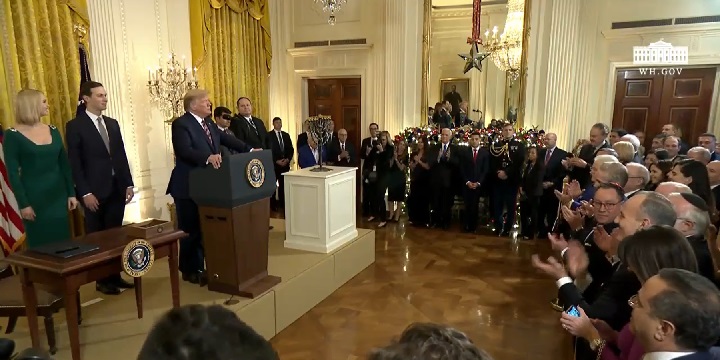
President Donald Trump speaking at a White House Hanukkah reception on Dec. 11, 2019. Photo: Screenshot / White House.
Major Jewish groups applauded the Trump administration on Wednesday for an executive order affirming civil rights protections for Jewish students, amid concerns over rising antisemitism on American campuses.
The order makes clear that Title VI of the Civil Rights Act, which applies to programs that receive federal funding, including colleges and universities, protects against “anti-Semitic discrimination based on race, color, or national origin,” according to a White House statement. It also calls for Title VI enforcement agencies to “consider” the International Holocaust Remembrance Alliance’s (IHRA) working definition of antisemitism and its supporting examples, which is already used by the US State Department.
While Title VI does not explicitly include religious protections, there have been multiple efforts — including stalled bipartisan legislation — to include the Jewish community and other minorities within its purview.
When serving as assistant secretary at the Office of Civil Rights (OCR) during the Bush administration in 2004, Kenneth Marcus clarified that protections afforded under Title VI also cover members of groups that “exhibit both ethnic and religious characteristics, such as Arab Muslims, Jewish Americans and Sikhs.”
The position outlined by Marcus — who is again serving as OCR chief in the current administration, and has probed several universities over concerns of antisemitic bias — was separately upheld under the Obama administration. In a 2010 letter, then Assistant Attorney General Thomas Perez affirmed that “discrimination against Jews, Muslims, Sikhs, and members of other religious groups violates Title VI when that discrimination is based on the group’s actual or perceived shared ancestry or ethnic characteristics, rather than its members’ religious practice.”
The Trump administration’s order was largely welcomed on Wednesday by Jewish groups — among them the World Jewish Congress, American Jewish Committee (AJC), the Zionist Organization of America, and the Anti-Defamation League (ADL) — which have urged increased action in the face of rising domestic and global antisemitism, particularly on college campuses. A recent AJC survey found that more than a third of Jews ages 18-29 had either experienced antisemitism on campus in the past five years, or know someone who had. According to ADL data, the number of reported antisemitic hate crimes and bias incidents on college campuses increased by more than 800 percent between 2011 to 2018, climbing from 22 incidents to 201.
Under the executive measure, “US institutions of higher education risk federal funding if they fail to act against antisemitic discrimination on their campuses,” stated leaders of the Conference of Presidents of Major American Jewish Organizations, whose members include the principal bodies of Reform, Conservative and Orthodox Judaism in the US. “We hope this will abate the increasingly virulent Jew-hatred on display at some colleges and universities across the country.”
Yet some left-leaning Jewish groups responded to the news with criticism of President Donald Trump, who was accused of making antisemitic remarks in a speech to the Israeli American Council last week. “President Trump has zero credibility to take meaningful action to combat the scourge of anti-Semitism for which he is partially responsible,” stated Halie Soifer, executive director of the Jewish Democratic Council of America.
The order also drew objections from free speech activists and those affiliated with the Palestinian-led boycott, divestment, and sanctions (BDS) campaign, who worry that enforcement of the IHRA definition — which calls out antisemitic critiques of Israel, such as claiming the state itself is a “racist endeavor” — could violate First Amendment rights.
In a statement, the Foundation for Individual Rights in Education argued that the while “the order is couched in language intended to paper over the readily evident threat to expressive rights, its ambiguous directive and fundamental reliance on the IHRA definition and its examples will cause institutions to investigate and censor protected speech on their campuses.”
Supporters have rebutted by pointing to language in the order mandating enforcement agencies to “not diminish or infringe upon any right protected under Federal law or under the First Amendment.”
“Under the Order, criticism of Israel can be, and often is, protected speech,” noted the ADL, “but the line must be drawn when such expression becomes intentional, unlawful, discriminatory intimidation and harassment against Jews.”