Moscow’s Trouble With Israelis Has a Deeper Meaning
Error: Contact form not found.

 by Israel Kasnett / JNS.org

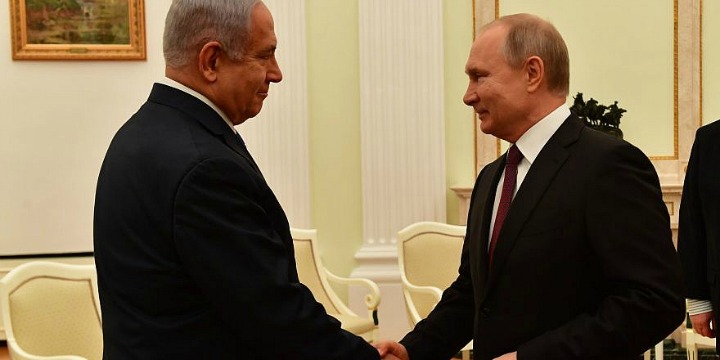
Israeli Prime Minister Benjamin Netanyahu and Russian President Vladimir Putin in Moscow on April 4, 2019. Photo: Kobi Gideon/GPO.
JNS.org – Israel has long had a complicated relationship with Russia. As an ally of some of the Jewish state’s fiercest enemies, such as Iran and Syria, Jerusalem interacts with Moscow carefully and purposefully, walking a fine line to maintain warm ties. However, the recent arrest and imprisonment of Israeli-American Naama Issachar in Russia has brought the complex relationship between the two countries into the public eye.
A Russian court rejected Issachar’s appeal on Thursday to mitigate her sentence of seven-and-a-half years in prison on drug offenses after a small amount of marijuana was found in her luggage at a Moscow airport in April. On the same day, 15 Israelis disembarking their plane in Moscow were taken in for questioning by Russian authorities; a similar incident involved 40 Israelis occurred earlier this week.
Israeli Prime Minister Benjamin Netanyahu has vowed to bring Issachar home.
“I am not a magician, but one thing I assure you. I will bring Naama Issachar home,” he said a recent rally in Haifa, whose imprisonment by Moscow has widespread outcry in Israel and remained in the headlines for months.
In what appears to have been meant as a not-so-subtle message to Israel, the Russian embassy in Israel stated in a tweet on Wednesday that many Russian tourists had been refused entry to Israel in 2019, including 569 in November alone. Both issues were being addressed in a Thursday meeting between Russian and Israeli diplomats in Jerusalem.
Referring to both of these cases, Micky Aharonson, former head of the foreign-relations directorate of the National Security Council in the Prime Minister’s Office and an expert on Russia at the Jerusalem Institute for Strategy and Security, told JNS that “this is not a consular matter. The Russians are sending us a message. They are not pleased with us, and this has been going on for a long time.”
The Syria arena has also created tensions between the two countries.
According to Aharonson, these cases are “surrounded by so many other things, such as the growing anger of the Russian military and security establishment towards Israel.”
For instance, after foreign-media reports emerged earlier this month that Israeli fighter planes carrying out a mission in Syria had to flee from Russian Su-35 planes, Russia came out in the media aggressively, stating that Israel used the airspace of Iraq and Jordan to carry out the mission. Since this was secret and not reported by Israeli media at the time, Russia’s tattling was perceived in Israel as revenge.
Aharonson also pointed to the incident of the Russian airplane that was shot down by Syria in September 2018 as a major point of tension between Israel and Russia, which appeared to have been resolved.
Regardless, Aharonson said the Russians are “discontent with our behavior.” They perceive themselves as having a positive approach to Israel, and they believe Israel is not reciprocating.”
‘Standard negotiation tactics’
Emil Avdaliani, an Eurasia analyst at the Begin-Sadat Center for Strategic Studies, told JNS that Israel’s detentions of Russians is what seems to be the real motivation behind Russia’s actions.
“Overall, the crisis was instigated right before the meeting of the diplomatic missions of the two states planned on December 19,” he said. “However, contrary to many opinion articles in the Russian media, the ‘manageable crisis’ is unlikely to turn into a showdown. The Russians simply generated a ‘manageable crisis’ to have an advantage before the talks start.”
Regarding the case of Issachar, Aharonson said “it is a tragic humanitarian case, but it has no impact on the strategic relations between the countries.” Her detention is a sign that Russia is displeased with Israel, he added.
Avdaliani pointed to major Kremlin-related media outlets, which state that indeed Issachar is a part of negotiations. “It is standard negotiation tactics,” he said. “Releasing Issachar is not in Russian interests; they would do so in exchange for concessions from Israel.”
Russia reportedly had been pressuring Israel to release Aleksey Burkov, an IT specialist arrested in 2015 on US charges of credit-card fraud, in exchange for Issachar, but last month he was extradited to the United States.
As for the relationship between Netanyahu and Russian President Vladimir Putin, Aharonson said that they have a “positive and respectful relationship, but none of this would hold if Russian interests were at stake. The gestures are there, and it is not to be taken for granted. Netanyahu treats him with a lot of respect, and we see reciprocity in that sense, but it is only until Russian interests are involved.”