


Iraqi Paramilitaries Call for Withdrawal From US Embassy in Baghdad
Error: Contact form not found.

 by Reuters and Algemeiner Staff

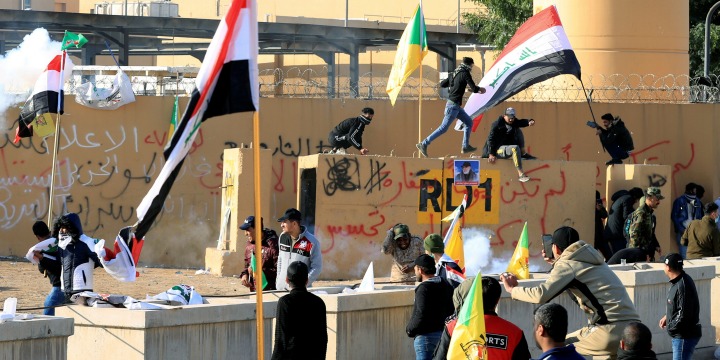
Protesters riot outside the US Embassy in Baghdad, Jan. 1, 2020. Photo: Reuters / Thaier al-Sudani.
Paramilitary groups who have been protesting against US air strikes in Iraq told their supporters to withdraw from the perimeter of the US Embassy in Baghdad on Wednesday, although there was no immediate sign of a pullout.
The embassy’s outer perimeter was stormed on Tuesday by demonstrators angry at US air strikes against an Iran-backed group that killed at least 25 fighters. On Wednesday, demonstrators hurled rocks at the building while security forces fired tear gas and stun grenades in an attempt to disperse them.
The Popular Mobilization Forces (PMF) umbrella group of mainly Shi’ite militia said the crowds should withdraw now that their “message has been heard,” and in deference to the Iraqi government which sought “to preserve the prestige of the state.”
The protests mark a new turn in the shadow war between Washington and Tehran playing out across the Middle East, and raise questions over the continued US military presence in Iraq. US President Donald Trump, who faces re-election in 2020, on Tuesday threatened to retaliate against Iran but said later he did not want to go to war.
The United States launched deadly air strikes against bases of the Iran-backed militia Kataib Hezbollah on Sunday in retaliation for missile attacks that killed a US contractor at a base in northern Iraq.
Crowds rallied on Tuesday to protest, chanting “Death to America,” setting fires, throwing rocks and smashing surveillance cameras. They breached an outer perimeter but did not enter the main compound.
The huge embassy, built along the banks of the Tigris River in central Baghdad’s fortified “green zone” during American occupation following the 2003 invasion that toppled Saddam Hussein, is the biggest US diplomatic mission in the world.
Washington says its diplomats are safe and it is rushing hundreds of extra troops to the region.
Overnight, demonstrators pitched tents and camped outside the embassy walls. On Wednesday morning, they were bringing in food supplies, cooking equipment and mattresses, suggesting plans to stay for a long time.
Senior Iraqi army officers had negotiated with those gathered outside the embassy in an attempt to convince them to leave but failed to do so. Washington is putting pressure on Iraqi leaders to ensure the security of its staff.
The anti-American action comes after months of protests in Iraq against the Iran-backed militias which support the government. Many Iraqis complain that their country has become a battlefield for a proxy war for influence between Washington and Tehran, and their leaders are too beholden to outside powers.
Iran‘s supreme leader, Ayatollah Ali Khamenei, condemned on Wednesday the US attacks. Iran summoned a Swiss envoy, who represents US interests in Tehran, to complain about what it described as “warmongering” words from Washington.
Trump accused Iran of orchestrating the violence at the US embassy and said Tehran would be held responsible.
More U.S. troops were being sent to the embassy, US officials said. The 750 troops would initially be based out of Kuwait. The officials said that as many as 4,000 troops could be sent to the region in the coming days if needed.
More than 5,000 US troops are stationed in Iraq supporting local forces. The air strikes have galvanized calls inside Iraq to expel US forces, not just from Iran-backed militias but also from their political rivals.