



Taking a Strong Stand Against Antisemitism
Error: Contact form not found.

 by Daniel Mandel

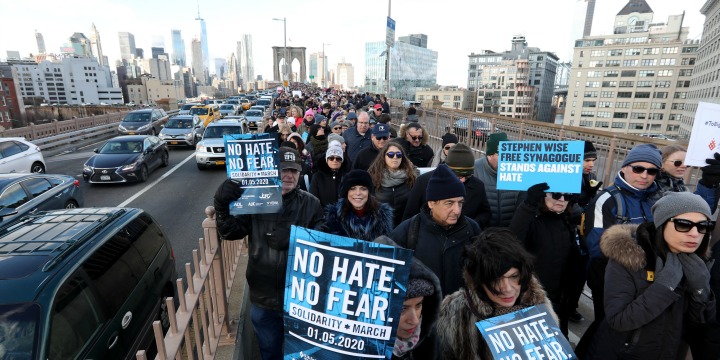
The ‘No Hate, No Fear’ march against antisemitism, New York City, Jan. 5, 2019. Photo: Seth Harrison / The Journal News, Rockland / Westchester Journal News via Imagn Content Services, LLC.
Week after week, there are new headlines of attacks on Jews walking the streets of ordinary, traditionally Jewish New York neighborhoods. Even a mere year or two ago, this was not a problem one would have expected to see in the post-World War II United States.
The problem is also large when viewed in the total context of hate crimes: in the the third quarter of 2019, anti-Jewish incidents comprised roughly half of all hate crimes recorded by New York City police.
A new menace to Jewish life, a reawakened antisemitism, reminiscent of the 1930s, is now with us. What is less well-acknowledged is that a high proportion of this antisemitic violence is being perpetrated by African-Americans.
After the Jersey City attacks, some local African-Americans despicably blamed Jews for living in the neighborhood and thus supposedly causing the attack.
Astonishingly, a local black official, Jersey City School Board member Joan Terrell-Paige, asked “Where was all this faith and hope when Black homeowners were threatened, intimidated, and harassed by I WANT TO BUY YOUR HOUSE brutes of the jewish [sic] community?” whom she accused of having “waved bags of money” in front of black homeowners. Terrell-Paige has been neither sacked nor officially censured.
In one of the five assaults in New York City during Hanukkah, a Jewish man walking in Crown Heights, Brooklyn was confronted by a gang of black youths screaming antisemitic obscenities, one of whom threw his drink at him.
In another assault, also in Crown Heights, a Jewish man was accosted by a group of eight black teenagers and knocked to the ground.
More serious still, a machete-wielding African-American man, Grafton Thomas, attempted to murder several Jews after entering a rabbi’s home in Monsey in upstate New York. Thomas stabbed five people, one of whom was seriously injured.
Why the relative silence about the identity of the attackers?
More than a century ago, Lord Alfred Douglas, the lover of Irish playwright and wit Oscar Wilde, devised a euphemism for the-then illegal activity of homosexual sex: “The love that dare not speak its name.”
Today, it’s as though it were illegal or grossly offensive to identify antisemitic acts committed by anyone other than whites.
As The New York Post wrote, New York City Mayor Bill de Blasio initially claimed in mid-December that “most” of the “violent and anti-Semitic attacks around this country” are “fermented systematically and in an organized fashion by right-wing forces” and insinuated that President Trump was also largely responsible. (He has since recanted this view, saying that antisemitism “transcends” politics.)
Similarly, Representative Rashida Tlaib (D-MI) initially asserted that the Jersey City attack was a case of “white supremacy.” Others described the Jersey City assailants as “drifters.” Grafton Thomas’ family asserted that Thomas’ attack in Monsey was the product solely of mental illness, despite police investigators having uncovered his journals expressing antisemitic views and Internet searches on his computer for subjects like “why did Hitler hate the Jews?” Still others opt for silence.
While it is heartening to observe that 25,000 people turned out for a solidarity rally with the Jewish victims on January 5, the questions still remains: Where are the African-American community leaders, local and national, decrying this anti-Jewish violence perpetrated by members of their community?
And what about New York City’s Democratic representatives? Senator Charles Schumer has condemned the attacks as “pure evil” and called for a Federal investigation. Representative Alexandria Ocasio-Cortez attended a rally to oppose the rise in antisemitism, along with fellow Democrats Carolyn Maloney, Max N. Rose, and Yvette Clark, who appears to be the only African-American Member of Congress to have attended. But why hasn’t she done anything to address the problem or talk about the nature of the attackers?
Only last October, Representative Ocasio-Cortez could be found absurdly accusing President Donald Trump of antisemitism. Now, when confronted by actual antisemitic assaults in the streets of her own city, where is her strong response?
Mayor de Blasio, it is true, had not been silent, observing, “It’s not enough to condemn antisemitism — we have to confront it. … The NYPD … will bring the perpetrators to justice.”
However, as the Orthodox Jewish newspaper Vos Iz Neias notes, Mayor de Blasio’s new policy of eliminating bail means some of the attackers can go right back onto the streets. As they write, “The mayor cannot claim to be serious about eliminating antisemitic attacks in the city, while at the same time refusing to keep the perpetrators of these very crimes off the streets.”
New York Governor Andrew Cuomo, has been forthright and active, describing the Monsey attack as a case of “domestic terrorism,” and issuing instructions to state police to increase patrols in Orthodox Jewish neighborhoods across the state. Indeed, Governor Cuomo and Senator Schumer have announced, respectively, state and Federal funding for enhanced security measures for Jewish religious institutions and synagogues. Yet the silence from many other Democrats and African-American leaders remains alarming and symptomatic of the problem.
The systematic ignoring, misidentification, and undervaluation of black antisemitic assaults is an unsustainable and unserious approach to a profoundly serious problem. Regrettably, at this moment, we have no reason to expect progress because the reluctance to confront black antisemitism is not mysterious: it stems from a general reluctance to condemn antisemitism committed by anyone other than white racists, because doing so would call attention to the widespread nature of the problem and beg the question of its durability and resurgence.
If a downtrodden community represents a noble cause, then the antisemitism that sullies that particular community becomes an unwelcome and accordingly unacknowledged reality. Few wish to inquire too closely why African-Americans, a minority still beset by social problems and a group for leftist corrective action, display two to three times more antisemitism than the national average.
Behind the violence we see today lies years of hate propagation by Louis Farrakhan’s Nation of Islam, elements of the Black Hebrews movement, and other black groups invested in antisemitism. Yet Members of the Congressional Black Caucus, by and large, have not shunned Farrakhan, much less condemned him (Charles Rangel, retired, being an exception); to the contrary, they have been willing to meet with him.
Any searching examination would soon reveal that antisemitism is not simply another bigotry, but rather an intellectual and spiritual disease that invests Jews with virtually supernatural capacity to harm humankind as the essential first step in mobilizing masses to persecute and even murder them.
Those who wish to rid the world of the Judeo-Christian moral and intellectual legacy can do no better than targeting its Jewish progenitors. This is why antisemitism has been rife across time and place, operates even without the normal stimulants of ethnic animosity or competition for territory or resources, afflicts people with genuine grievances unrelated to Jews, and even appears in societies devoid of Jews.
Daniel Mandel, historian and publicist, is a Fellow in History at Melbourne University (Australia) and, since 2005, Director of the Zionist Organization of America’s Center for Middle East Policy.