




Israeli and Palestinian Farmers Pay the Price as Politicians Bicker
Error: Contact form not found.

 by Reuters and Algemeiner Staff

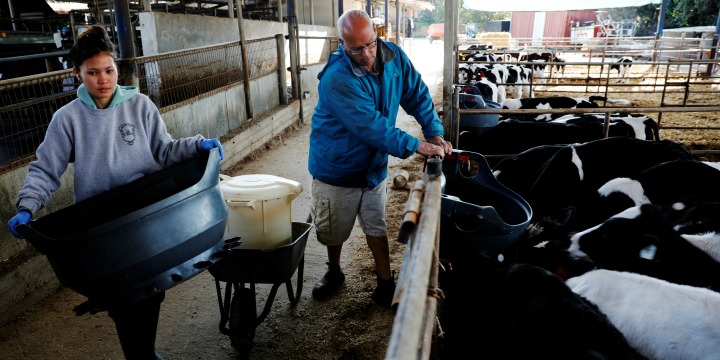
A laborer and Israeli farmer Guy Golan tend to calves in their shed at his farm in Be’er Tuvia, southern Israel, Feb. 5, 2020. Photo: Reuters / Amir Cohen.
Israel and the Palestinian Authority have opened a new front in their decades-long conflict by getting locked in a trade dispute — and farmers on both sides of the border are paying the price.
Palestinian Mowafak Hashim, who farms fruit and vegetables in sun-baked Jericho in theWest Bank, says he supports moves by the Palestinian Authority (PA) to end imports of Israeli agricultural products.
But he also fears the breakdown in a usually smooth-running cross-border trade relationship will ruin his business.
“I won’t find alternative markets… since the (Israeli) occupation controls the checkpoints,” said the 51-year-old, referring to Israel‘s control over the West Bank’s border crossings.
The PA announced a boycott of Israeli calves in October. Last weekend, Israeli Defense Minister Naftali Bennett said he would halt all PA agricultural imports, which in turn prompted the PA to say it would end imports of Israeli agricultural products, fruit juice and bottled water.
Those tit-for-tat moves have frayed trade links that have generally held strong since the two sides signed interim peace accords in the 1990s, even weathering the collapse in 2014 of peace negotiations.
The actions of the PA, whose power base is in the West Bank, in part reflect greater efforts to end what its leaders — including new PA Prime Minister Mohammed Shtayyeh — see as an over-dependence on Israeli markets.
A second Palestinian farmer, 54-year-old Hisham Qutaishat, concurs with that approach.
“The PA should start a comprehensive national and strategic plan to connect the needs of the Palestinian market to what Palestinian farmers produce,” he said.
“That way, we will not fall victims to any (Israeli) decision like this in the future.”
But in the meantime, with the announcement of US President Donald Trump’s Middle East peace plan further fueling bilateral tensions, producers on both sides are suffering.
The West Bank currently sends over two-thirds of its farming exports to Israel, whose Agriculture Ministry says the calves boycott has affected around 400 Israeli cattle breeders, costing them a total of $70 million since October.
In Be’er Tuvia, a southern Israeli agricultural village, cattle farmer Guy Golan said he sells around 400 calves annually to the Palestinian market, earning him 2.5 million shekels ($725,000).
“This boycott hurts our business very, very much … The cows go on and give birth, and the young calves, they’re not able to go anywhere,” Golan said.
“We can’t buy and we can’t sell, everything is stuck.”