










Is Israel’s Intolerance of Non-Orthodox Sects Alienating American Jewry?
Error: Contact form not found.

 by Jason Shvili

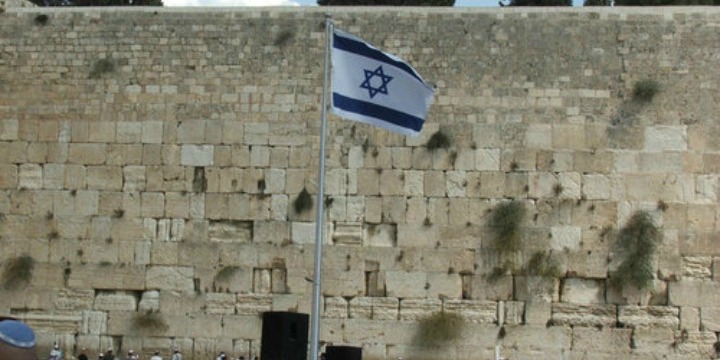
The Israeli flag at the Western Wall in Jerusalem. Photo: Hynek Moravec via Wikimedia Commons.
A recent survey conducted by the Ruderman Family Foundation found that 80% of American Jews define themselves as pro-Israel. The same survey indicated that 67% of Jews in the US felt “attached” or “very attached” to Israel. In addition, more than 70% of American Jews say that their attachment to the Jewish state is just as strong, or stronger, than it was five years ago. This is welcome news at a time when many Jewish leaders both in Israel and the US have warned of a growing disconnect between the State of Israel and American Jewry.
The numbers mentioned above, however, do not tell the whole story of what has transpired lately in the relationship between Israel and the American Jewish community. In reality, there is a great deal of tension between the two. Just because the overwhelming majority of Jews in the US support Israel’s existence does not necessarily mean that they support Israel’s policies.
There have always been divisions between American Jews and Israel, just as there are divisions within American Jewry itself. Most of these divisions revolve around the seemingly unending debate about what makes a person a Jew, and how Judaism should be practiced.
For example, whereas Jewish congregations in the US belong to several different streams of Judaism, the State of Israel recognizes only one official stream of Judaism: Orthodox Judaism. This has always been a source of great tension between Israel and American Jewry, especially since the majority of Jews in the US do not consider themselves Orthodox. Many American Jews have long resented the fact that their way of practicing the Jewish faith is not recognized by the one and only Jewish state.
In 2017, this religious divide was front and center when the Israeli government cancelled an arrangement that was to designate an area at the Western Wall for an egalitarian prayer space, where men and women could pray together.
The current practice at Judaism’s holiest site is for men and women to pray separately, in keeping with Orthodox tradition. For many American Jews, not to mention non-Orthodox Jews in other parts of the world, this policy reversal was a slap in the face. The refusal of the State of Israel to recognize different ways of practicing Judaism raises a very important question: How can Israel ask American Jews for their continued support, but at the same time, say that the way they practice the Jewish religion is not welcome there?
The reality is that there are Israelis who don’t care if men and women pray together at the Western Wall, or, for that matter, at any other Jewish holy site in the country. In fact, many Israelis would like to see room made for other streams of Judaism to flourish in the Jewish state. Unfortunately, however, these more liberal-minded Israelis are drowned out by the powerful Orthodox establishment.
The Orthodox monopoly on all matters related to the practice of Judaism in Israel dates back to before the Jewish state came into being. David Ben-Gurion, who would become Israel’s first prime minister, and the rest of the Zionist leadership in what was then the British Mandate, needed the support of the religious Jewish establishment there in order to buttress their case for the creation of a Jewish state. The religious Jews agreed to support the Zionist cause, but under the condition that their Orthodox tradition would govern matters related to observance of the Sabbath, Kashrut (kosher laws), and marriage. This is often known as the Status Quo Agreement, which has remained in effect in Israel to this day.
Giving recognition to other streams of Judaism would constitute a breach of this arrangement, which is why Israel’s Jewish religious parties continue to fight tooth and nail to ensure that such a breach never takes place. It is these religious parties that almost always hold the balance of power in Israel’s coalition governments, so any attempts to change the status quo are routinely blocked.
Unless there is a fundamental change in Israel’s politics, the Orthodox monopoly on Jewish religious practice will remain in place, as will the tension between Israel and American Jews, who feel alienated by the Jewish state’s refusal to recognize other ways of being Jewish. Nevertheless, as the aforementioned Ruderman Family Foundation survey suggests, most American Jews still support Israel. How long they will continue to do so should its government not make room for pluralism in the Jewish religion, however, remains to be seen.
Jason Shvili is a freelance writer in Toronto, Canada.


