





Iranians Vote in Parliamentary Election, Hardliners Set to Dominate
Error: Contact form not found.

 by Reuters and Algemeiner Staff

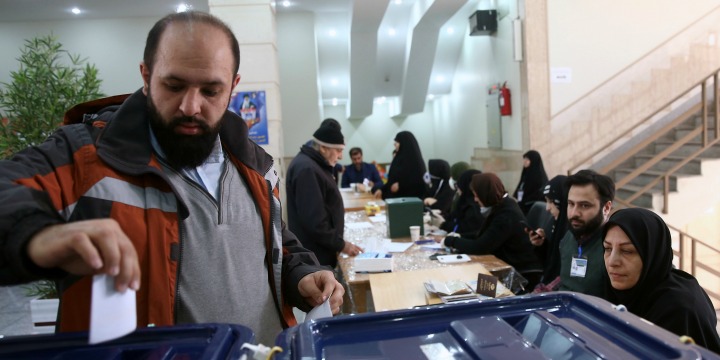
A man casts his vote at a polling station in Tehran, Iran, Feb. 21, 2020. Photo: Nazanin Tabatabaee / WANA (West Asia News Agency) via Reuters.
Iranians were voting on Friday in a parliamentary election likely to help hardline loyalists of the supreme leader tighten their grip on power as the country faces mounting US pressure over its nuclear program and growing discontent at home.
With thousands of potential candidates disqualified in favor of Ayatollah Ali Khamenei’s allies, the vote is not expected to ease the country’s nuclear standoff with the United States or lead to a softer foreign policy.
The 290-member parliament’s power is limited, but gains by security hawks could weaken pragmatists and conservatives who back the ruling theocracy but support more engagement with the outside world.
More hardline seats in the Assembly may also help them in the 2021 contest for president, a job with wide day-to-day control of government. President Hassan Rouhani, from the pragmatist faction, won the last two elections on promises to open Iran to the outside world.
Washington’s 2018 withdrawal from Iran‘s nuclear deal with world powers, and its reimposition of sanctions, have hit Iran‘s economy hard and led to widespread hardships.
A US drone strike killed Iran‘s most prominent military commander, Qassem Soleimani, at the Baghdad airport on Jan. 3.
Iran retaliated by attacking US targets in Iraq with ballistic missiles, killing no one but causing brain injuries in more than 100 soldiers.
Encouraging Iranians to vote, State TV showed footage of people lined up at polling stations set up mainly at mosques.
“I am here to vote. It is my duty to follow martyr Soleimani’s path,” said a young voter at a mosque at a cemetery, where Soleimani is buried in his hometown.
Soleimani, architect of Tehran’s overseas clandestine and military operations as head of the Revolutionary Guards’ Quds Force, was a national hero to many Iranians. He was Iran‘s most powerful figure after Khamenei.
“Each vote put into the ballot box is a missile into the heart of America,” said Amirali Hajizadeh, head of the aerospace unit of the Revolutionary Guards.
Rouhani urged Iranians to demonstrate “victory” by voting in large numbers. “Our enemies will be further disappointed by the high turnout,” he said after voting.
Turnout is seen as a critical test of the popularity of the clerical establishment.
Many Iranians who took part in large protests in November demanded their leaders focus on the economy and tackling corruption.
Iranian authorities predicted a turnout of about 50%, compared to 62% and 66% respectively in the 2016 and 2012 votes.
Four hours after polls opened, an Interior Ministry official said about 5 million Iranians out of 58 million eligible voters had cast their ballots, the ISNA news agency reported.
Iranians contacted by Reuters by telephone said turnout was low in some districts in the capital.
“In my area in central Tehran not many people are voting. There is one polling station just beside my house in Javadiyeh and only a handful of voters were there when I last checked an hour ago,” said sports teacher Amirhossein, 28.
State television said voting would run for 10 hours, but could be extended for a couple of hours depending on turnout.
‘Religious duty’
The slate of hardline candidates is dominated by loyalists to Khamenei, including former members of the Guards, who answer directly to the supreme leader, and their affiliated Basij militia, insiders and analysts say.
Former Guards commander Mohammad Baqer Qalibaf tops the parliamentary list of the main hardline coalition for Tehran’s 30 seats in the assembly.
Khamenei was the first to cast his vote, broadcast live on television.
“Voting is a religious duty … which will also guarantee the national interests of Iran,” he said.
With Iran facing growing isolation on the global stage and discontent at home over economic hardship, analysts have described the election as a litmus test of the leader’s handling of the political and economic crises.
The Guardian Council removed 6,850 moderates and leading conservatives from the field, and permitting voters a choice mostly between hardline and low-key conservative candidates loyal to Khamenei.
On Thursday, the US Treasury Department imposed sanctions on members of the Guardian Council and its Elections Supervision Committee over the candidate bans. The spokesman for the Guardian Council said he was honored to be blacklisted by the United States.
Iran‘s clerical establishment has faced a legitimacy crisis since last year when protests over a fuel price hike turned political with demonstrators calling for “regime change.” The unrest was met with the bloodiest crackdown since the 1979 Islamic Revolution, killing hundreds.
Many Iranians are also angry over the shooting down of a Ukrainian passenger plane in error in January that killed all 176 people on board, mainly Iranians. After days of denials, Tehran said the Guards were to blame.


