







Attacks Prompt Swift UK Legislation Blocking Terrorists From Early Prison Release
Error: Contact form not found.

 by Patrick Dunleavy


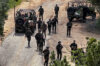
Police forensics officers are seen near a site where a man was shot by armed officers in Streatham, south London, Britain, February 2, 2020. Photo: REUTERS/Simon Dawson.
The United Kingdom has just passed emergency legislation that will stop the early release of convicted terrorists from prison. This decisive action comes on the heels of two recent terror attacks in London by jihadists who were released from prison earlier than the end of their sentences for terror-related crimes.
In November, Usman Khan, who had served eight years in prison before being granted an early release, killed two people and wounded three others in an attack near London Bridge. Khan was wearing a fake suicide vest when he committed the attack. Khan participated in a de-radicalization program. Clearly, the program did not guarantee that Khan was genuinely rehabilitated or would not re-offend.
The second attack came in February, when Sudesh Amman, 20, stabbed two people in the Streatham section of South London. Amman had been released from prison just a week earlier, after he had served about half of his 40-month prison sentence for a 2018 terror conviction.
Undercover police were watching Amman, but they were not able to stop his stabbing spree. He was shot and killed by police within a minute.
The legislation enacted Wednesday blocks early release for about 50 imprisoned extremists, a statement from the UK Ministry of Justice said. It requires that any inmate convicted of a terror-related crime, such as training for terrorism, membership in a terror organization, or disseminating terrorist literature, must complete at least two-thirds of his or her sentence before being considered for release. Even then, the release is not guaranteed.
“No terrorist should be released early only to kill and maim on our streets,” said Justice Secretary and Lord Chancellor Robert Buckland. “Protecting the public is Government’s first duty and our message is clear — enough is enough.”
The inmate now must appear before an independent Parole Board, which will assess whether the offender’s release poses a threat to the public. The new law also places stringent post-release conditions on the parolee, which could include restrictions on travel and communications, and imposed curfews.
The legislation is a step in the right direction, but should not be viewed as a guarantee that released terrorists won’t strike again. Both Usman Khan and Sudesh Amman were wearing electronic monitors when they committed their murderous terror attacks. Amman was under post-release restrictions that included surrendering his passport and limiting his use of cell phones and Internet access.
Perhaps the most effective measures in the new legislation are tougher sentencing laws for terrorists and an increase in counter-terrorism personnel necessary to monitor released terrorists effectively.
The UK’s swift legislative response — passing just two weeks after Amman’s terrorist attack — should be recognized by US lawmakers. Similar legislation to end early prison release for convicted terrorists, and enhance post-release conditions once their terms are completed, has been sitting idle since last May when Senators Tom Cotton (R-AR) and Richard Shelby (R-AL) introduced it.
It shouldn’t take two terrorist attacks like London has recently endured for the issue to be taken seriously. Amman and Khan could become role models for convicted jihadis still harboring a lust for blood and martyrdom.
Without similar legislation, convicted terrorists here will continue to look for their cell doors to be opened early.
Patrick Dunleavy is a senior fellow at the The Investigative Project on Terrorism, the former Deputy Inspector General for New York State Department of Corrections, and author of The Fertile Soil of Jihad. He currently lectures a class on terrorism for the United States Air Force’s Special Operations School.
A version of this article was originally published by The Investigative Project on Terrorism.


