




Gantz Won’t Form a Government With Arab Parties Because of Arab Hatred — Not Racism
Error: Contact form not found.

 by Adam Levick

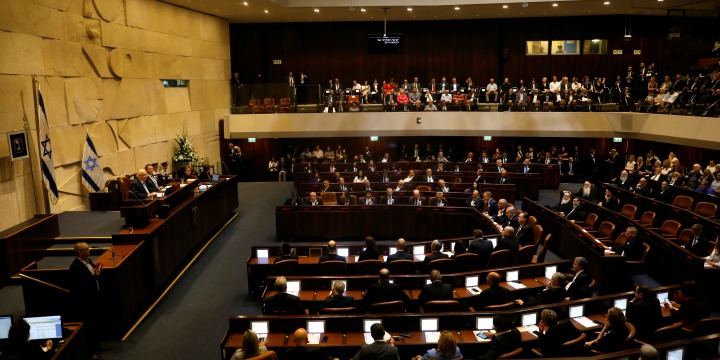
Israeli President Reuven Rivlin addresses the opening session of the 22nd Knesset, in Jerusalem Oct. 3, 2019. Photo: Reuters / Ronen Zvulun.
Yair Wallach, a senior lecturer in Israeli studies and head of the Centre for Jewish Studies at SOAS, the University of London, published an op-ed in The Guardian on March 5 (“Palestinian voters are the new power brokers in Israel, much to Netanyahu’s chagrin”).
Wallach argues that Arab citizens of Israel who voted for the Joint List helped keep Benjamin Netanyahu from forming a majority in the Israeli elections. He also claims that the “refusal to strike an alliance with Palestinian citizens [the four Arab parties that make up the Joint List] remains the primary reason for the failure of the center-left parties” to form a government, which he characterizes as “racist.”
The racist logic of a “Jewish majority” still forms the basis of mainstream politics. As recently as last month, Blue and White pledged not to include the Joint List in its future government, despite its endorsement of Gantz. Some members of Blue and White are ideologically opposed to the inclusion of Palestinians; others are fearful that it would drive Jewish voters away.
However, racism isn’t the reason why Blue and White won’t include the Joint List in its future government. It’s because Joint List represents a coalition of non-Zionists or outright anti-Zionists. Included in the Joint List is the communist Arab-Jewish party Hadash, the Muslim religious party Ra’am, and the anti-Zionist Balad.
Further, as we noted in a previous post, several leading MKs from the Joint List have expressed support for terrorists convicted of murdering Israeli civilians. Though there is currently talk that center-left parties who oppose Netanyahu are considering forming a minority government with outside support of the Joint List (aka, a confidence-and-supply agreement), the reluctance to actually bring them into the government is based on ideology, not bigotry.
Wallach continues:
The Trump “peace plan”, endorsed by Netanyahu, called for the transfer of many Palestinian citizens to the future Palestinian “state.” The alarming prospect of being deprived of their citizenship, and forcibly removed to a fragmented Bantustan-style statelet in the West Bank, drove many to the polling booths.
This is misleading and inaccurate.
Under the US plan, there would be no physical transfer of citizens. The plan calls for moving the borders of Israel to the east, so that Arab Israelis in what’s known as the Arab triangle area would remain where they are, but become part of the state of Palestine. More importantly, Netanyahu has emphatically rejected this idea.
Wallach then opines:
In the past two decades, Israeli public opinion has shifted clearly to the right.
As we’ve argued previously, this is an extremely facile and misleading way of understanding Israel’s political shift.
Israelis haven’t moved “right” insofar as the word denotes an embrace of militarism and a disinterest in pursuing peace and coexistence with the Palestinians.
They’ve simply changed their minds — based entirely on experience — about the efficacy of the current peace process and the assumption that territorial concessions will necessarily end, or even reduce, Palestinian violence.
As center-left Israeli writer Yossi Klein Halevy argued, it’s impossible to understand the Israeli electorate in 2020 without acknowledging the concerns of the broad Israeli center, who understand that though the status quo is untenable in the long term, and leaders must do all they can to achieve peace, fear that “a precipitous territorial withdrawal could turn the West Bank into another Gaza, risking a Hamas takeover and rocket attacks on Israeli cities.”
Moreover, on some non-security related issues, as such support for gay marriage (or civil unions) and LGBT surrogacy rights, Israelis have actually moved left.
Wallach’s insistence on framing the complex Arab-Israeli political divide through the facile lens of the Palestinian (progressive) David battling the Israeli (far-right) Goliath, rather than engaging in a sober analysis of the ideological fissures which separate Jewish and Arab parties, serves to reinforce Guardian readers’ immense misunderstanding of Israel’s messy but undeniably democratic reality.
Adam Levick covers the British media for CAMERA, the 65,000-member, Boston-based Committee for Accuracy in Middle East Reporting in America.