


Overwhelmed by Growing Coronavirus Death Toll, Iranian Leaders Lash Out at US, EU
Error: Contact form not found.

 by Algemeiner Staff

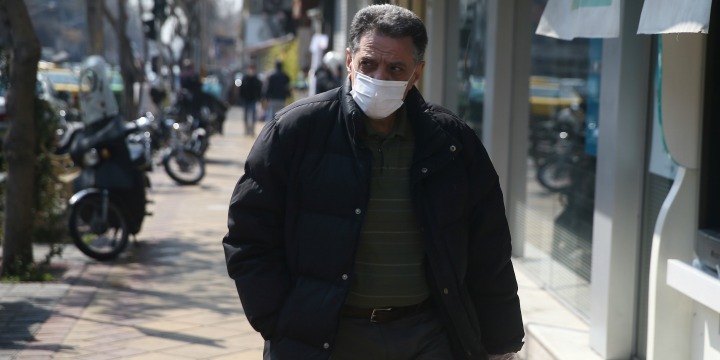
An Iranian man wears a protective face mask, following the coronavirus outbreak, as he walks in Tehran, March 5, 2020. Photo: WANA (West Asia News Agency) / Nazanin Tabatabaee via Reuters.
As Iran experienced its worst death toll from the coronavirus pandemic this week, panicking Tehran regime officials sought to blame the United States and the European Union for the crisis.
In an interview with the Spanish newspaper La Razon, Hassan Qashqavi — the Islamic Republic’s ambassador in Madrid — railed against the “cruel and inhumane” sanctions imposed by the US following its 2018 decision to leave the nuclear deal with Iran that was agreed with the previous Obama administration.
The 147 coronavirus deaths in Iran on Wednesday marked the highest daily toll in the country so far. Nearly 1,200 Iranians in total are reported to have died — although the regime’s lack of transparency and increasing reliance on the Islamic Revolutionary Guard Corps (IRGC) to enforce “social distancing” protocols likely means the number is higher.
The European Union also came in for heavy criticism from Iranian leaders for abiding by the US sanctions.
“The Europeans who claim to be advocates of human rights should be ashamed of their behavior at a time when Iran is grappling with the fast-spreading-virus,” Ali Baqeri Kani — head of the Iranian Judiciary’s High Council for Human Rights — declared on Thursday.
There is a growing opinion among Iran analysts that the coronavirus presents an unprecedented challenge to the Islamic regime that came to power in 1979, especially as it had already been weakened by the renewal of international sanctions and the US assassination of one of its top military commanders, Gen. Qassem Soleimani, in January.
“The regime is not ready for this challenge,” Maj. Gen. (ret.) Yaakov Amidror — a former Israeli national security adviser — told a conference call organized by the Jewish Institute for National Security Affairs (JINSA) on Thursday.
Amidror also observed that Iran had become the “epicenter” of the virus in the Middle East, “because people were flying to Beirut from Iran and back, and the Iraqis didn’t close their border with Iran.”
Calls to alleviate sanctions on the regime without a corresponding requirement to end the Iranian nuclear program were “a huge mistake,” he added.