


On an Empty Via Dolorosa Before Easter, Praying for the World’s Sick
Error: Contact form not found.

 by Reuters and Algemeiner Staff

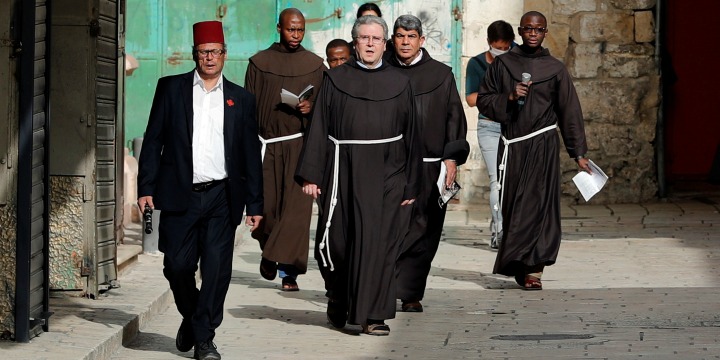
Father Francesco Patton, the Custos of the Holy Land for the Roman Catholic church, and other Franciscan Friars walk toward the Church of the Holy Sepluchre, amid the coronavirus disease (COVID-19) outbreak, in Jerusalem’s Old City, March 27, 2020. Photo: Reuters /Ammar Awad.
Brown-robed Franciscans stride through a shuttered and deserted Jerusalem to the Church of the Holy Sepulchre, the global focus of the most important festival in the Christian calendar — but in a city bereft of Easter pilgrims.
Among them is Father Francesco Patton, 56, the custodian of the Holy Land for the Roman Catholic church, responsible for protecting its sacred sites.
“We are living in strange days. Usually at this time the Old City was full of …pilgrims coming for Holy Week,” he said after his group prayed outside the locked door of the church that is their base.
The Franciscans’ ceremonial walk along the Via Dolorosa marks the journey that Christians believe Jesus took to his crucifixion and resurrection.
This Easter the route bears new bronze reliefs depicting that journey, a gift from Verona sculpted by Italian artist Alessandro Mutto. But there is no one to see them.
“Now it is a little bit sad to see that …nobody is able to walk (it). But we know that at this moment so many people are walking a personal Via Dolorosa, when I think of those who are in the hospital and in their houses fighting with coronavirus,” Patton said.
COVID-19 has infected more than 8,600 in Israel, with 52 fatalities. Residents are locked down in their homes for all but essential activities, which do not include religious ceremonies.
So the Christian denominations that share custody of the Holy Sepulchre face closures unprecedented in living memory, as do Jewish and Muslim leaders in a city that has sites sacred to all three faiths. Passover, Easter and Ramadan all fall this month, with Catholics celebrating Easter on April 12.
Like other clergy, Patton’s Franciscans conform with social distancing guidelines as they say prayers along the Via Dolorosa, stopping at the 14 Stations of the Cross that mark events leading up to Jesus’ burial.
When they arrive at the Sepulchre, they pray for the sick and the dying around the world, and the medical staff treating them – as Patton’s predecessors treated the sick in medieval times.
“A small Franciscan community started to live in the Holy Sepulchre in 1333, so you can imagine what it means for us, this place,” Patton said.
“…The responsibility to pray in the place in which Jesus conquered death, to pray for all those who are, in this moment, very (much) in the face of death.”