







With US-Taliban Deal, Will Iran Seek to Fill Power Vacuum in Afghanistan?
Error: Contact form not found.

 by Jackson Richman / JNS.org

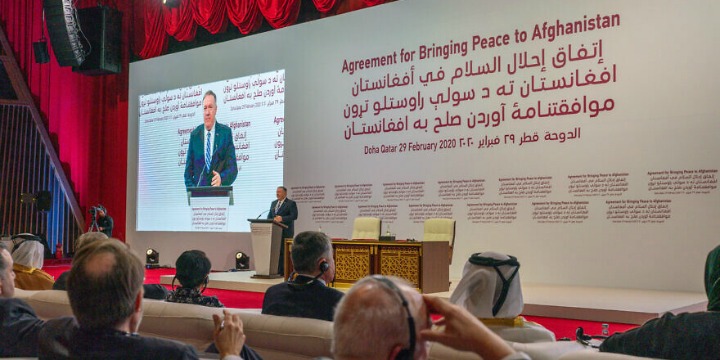
US Secretary of State Mike Pompeo participates in a signing ceremony in Doha, Qatar, on Feb. 29, 2020. Photo: State Department Photo by Ron Przysucha.
JNS.org – The United States and the Taliban signed an agreement on Feb. 29 that includes the possible eventual withdrawal of all American and other NATO forces from Afghanistan by next year contingent on the Taliban upholding commitments such as holding talks with the Afghan government.
Currently, the United States is drawing down its troop count in the country to 8,600.
The deal also includes a prisoner swap between the Taliban and the Afghan government.
Back in the United States, the agreement has been decried on both sides of the aisle, with critics pointing to a potential power vacuum similar to what happened following the withdrawal of US forces from Iraq in 2011, which led to increased Iranian influence, as well as the creation of ISIS, the Islamic State terror network.
“I’m worried about how Iran interferes potentially with that deal,” Rep. Michael Waltz (R-Fla.), a US Army veteran who served in Afghanistan and was director of Afghanistan policy at the Pentagon under US President George W. Bush, told JNS the day after the deal was signed.
“This is the beginning of a process, not the end of one. We can’t have a situation where the Taliban take advantage of these talks in order to gain strength in the wake of a US withdrawal that then enables Al-Qaeda and ISIS,” he said. “I think the administration has their eyes wide open, and they have a lot of protections in place to prevent that from happening. But I’m watching very closely.”
Rep. Brad Sherman (D-Calif.), a member of the House Foreign Affairs Committee, called the agreement a “phase deal” and a wait-and-see approach.
However, he told JNS, “you cannot prevent the terrorists from getting a small facility,” citing that the 9/11 attacks were planned at an apartment in Hamburg. “You must prevent them from having the infrastructure of a state and a huge facility a Tora Bora.”
“So we’ll see,” continued Sherman. “First, we want peace for the people of Afghanistan. We want a reasonable coalition government, we insist upon suppression of terrorists, and we’ll see how this works out.”
Afghanistan shares a 570-long-mile border with the Islamic Republic. Relations between the two peoples date back millennia with modern diplomatic ties being formalized in 1935. Both the Afghani and Persian people share cultural traits, such as celebrating the Persian new year of Nowruz; and the Dari language, an eastern dialect of Persian, is an official language in Afghanistan.
While both countries are Muslim, Afghanistan is predominately Sunni, while Iran is Shia. As a result, since the 1979 Iranian Revolution, relations between the two have been strained.
Iran could ‘exploit’ vacuum in Iran
Barbara Slavin, who leads the Atlantic Council’s Future Iran Initiative, told JNS that the “Trump administration clearly wants to draw down in the region and is frustrated with the apparent inability of the Afghan government to put forward a unified delegation to negotiate with the Taliban. The Iranians would like a reduction in the US troop presence, but also benefit from having potential American targets in Afghanistan should hostilities between the United States and Iran increase.”
United Against Nuclear Iran policy director Jason Brodsky told JNS that the agreement just isn’t feasible right now.
“The US deal with the Taliban comes on the heels of the head of US Central Command revealing an uptick in Iranian malign activity in Afghanistan,” he emailed. “Given the deep experience of the new commander of the Islamic Revolutionary Guard Corps’ Quds Force Esmail Ghaani in Afghanistan, my concern is that Iran will exploit the vacuum that’s being created in the withdrawal of US troops to advance its interests in the region.”
Ilan Berman, senior vice president of the American Foreign Policy Council, told JNS that he recognizes why the Trump administration wants to leave Afghanistan after almost 19 years, the deal is alarming.
“The rationale behind the Trump administration’s decision to conclude a truce with the Taliban is understandable because the White House has made very clear that it is seeking an exit from ‘forever wars’ like Syria and Afghanistan,” said Berman.
“However, the terms of the agreement itself should be concerning because they empower the Taliban politically without forcing it to make any real, substantive changes in its behavior,” he explained. “That’s problematic because if the Taliban is emboldened and steps up its assault on the Afghan state as a result, it will have the effect of inevitably dragging us back into Afghanistan, even if we leave now.”
Berman noted the ongoing tension, including border clashes, between Iran and the Taliban in the late 1990s and early 2000s, and that the two are “only tactically” allies because the Taliban is in the opposition in Afghanistan, whereby Iran and the Taliban have sought to overthrow the government in Kabul.
‘Broader concern about an American retreat’
Jonathan Schanzer, senior vice president of research at the Foundation for Defense of Democracies, told JNS that Iran wouldn’t be the only geopolitical threat that could take advantage of a power vacuum left by the United States in Afghanistan.
“A lot of what’s happening on the Afghan issue relates to this sort of debate whether we can or should pivot to China and to deal with the China challenge,” he said. “What I think has been lost in all of this is the fact that China is a neighbor of Afghanistan, and they will have an opportunity to fill some of the void to the extent that they’re willing to.”
He added that “if we’re also trying to contain Iran, which has been a primary focus of the Trump administration, Iran is another actor that has a border with Afghanistan and has had some involvement in the conflict. I’m not quite sure I understand some of the logic that’s gone into this, but I think there’s a broader question that continues to come up—which is what happens to American deterrence after we waive the white flag, and that is what we’ve done.”
He added that the deal “bodes poorly” for US deterrence and US allies in the Middle East, including Israel, Saudi Arabia, the United Arab Emirates, Jordan and Egypt.
Finally, Schanzer noted that “there’s a broader concern about an American retreat in the region even if Afghanistan doesn’t touch the Levant.”
In other words, he said, “A lot of countries are scratching their heads, wondering where will America decide to retreat from next.”