










How to Bridge the Diaspora-Israel Gap
Error: Contact form not found.

 by David Fine / JNS.org

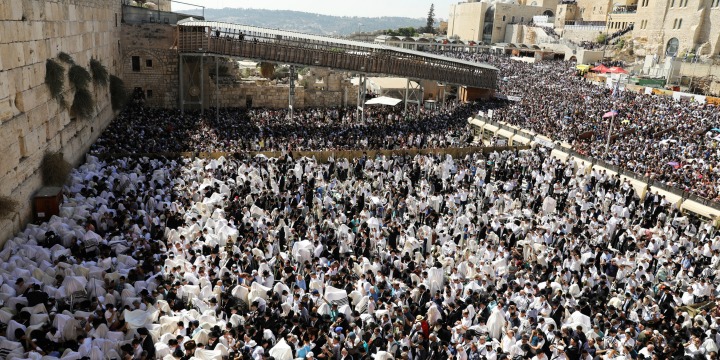
A general view shows thousands of Jewish worshippers attending the priestly blessing on the Jewish holiday of Sukkot at the Western Wall in Jerusalem’s Old City September 26, 2018. Photo: REUTERS/Ammar Awad.
JNS.org – The Israel-Diaspora relationship has always been complex and fraught with landmines, and during crises has experienced many extremes, from complete solidarity to creeping alienation. A difference in geography, perspective, and history accounts for a large part of that.
Over the past several weeks, the coronavirus crisis has hit the Jewish communities around the world hard, disproportionately killing more Jews than the general population in places like New York and London. In a recent conference call with Jewish community leaders hosted by Israel’s Diaspora Affairs Ministry, Israeli leaders basically asked their counterparts for suggestions on how Israel can best assist them.
During global crises, the Israeli government and the Israel Defense Forces are often at the forefront with regard to offering assistance to beleaguered populations. While Israel can rarely send the largest of delegations, it offers sophisticated and innovative answers to challenges during crises. In the current crisis, Israel could do a lot — for instance, sharing with community leaders best practices about getting ahead of the virus and “flattening the curve.”
According to its own website, Israel’s Diaspora Affairs Ministry is entrusted with fostering the connection between world Jewry and the State of Israel through joint activities and ongoing dialogue; the Israeli government sees itself as being responsible for all Jews worldwide, whether they live in Israel or the Diaspora. Unfortunately, while the words are lofty, the portfolio is still largely seen as a consolation prize for aspiring ministers, with a budget of barely NIS 12 million ($3.4 million) out of a national budget of NIS 400 billion ($113.4 billion).
In light of the lessons learned from the coronavirus pandemic, Israel should set up a permanent joint Israel-Diaspora task force to deal with this and future crises, from pandemics to antisemitic attacks to social or even spiritual crises. The task force would operate along the lines of the European Jewish Congress’ Security and Crisis Centre.
The Israeli rabbinate could be utilized in conjunction with the Diaspora Affairs Ministry to help Jews around the world meet some of their spiritual needs. It could enlist Jewish communities in Israel to hold Zoom prayers, and pair and partner with Jewish communities in the Diaspora that are unable to form a minyan. Such a program could be expanded to meet other needs during non-crisis times, perhaps helping those too ill or infirm to attend synagogue or conducting joint learning projects. This could potentially bring Jewish communities in Israel and the Diaspora closer together, demonstrating the dictum that kol Yisrael arevim zeh l’zeh (“all Jews are responsible for one another”).
Earlier in the year, I helped form an organization called the Anglo Vision. We are a rapidly expanding group of English-speaking Israelis who seek to coalesce our community around a vision of unifying positions that can affect change, development, and progress, and above all, contribute to our beloved homeland.
Since we started, I have been contacted by hundreds of immigrants to Israel with many great ideas, especially during this crisis. We came from the Diaspora, we still have roots, family and friends in the countries of our birth, and so we have an unequaled understanding of its needs. We are a resource that should be tapped by Israeli decision-makers to understand how to fulfill the vision of being an inseparable people.
The next Israeli government should improve the standing of the Diaspora Affairs Ministry with increased budgets, resources, and capabilities. The Jewish people need this, Israel needs this, and we who came from the Diaspora and now live in Israel can serve as the most secure and robust bridge.
Rabbi David Fine is founder of the Anglo Vision and founder and dean of the Barkai Center for Practical Rabbinics and Community Development, an organization dedicated to building Israeli society one community at a time by successfully bringing Diaspora models of community building to Israel. Anglo Vision can be contacted at TheAngloVision@gmail.com.


