



The Beirut Blast Changes Everything for Hezbollah
Error: Contact form not found.

 by Yoav Limor / JNS.org

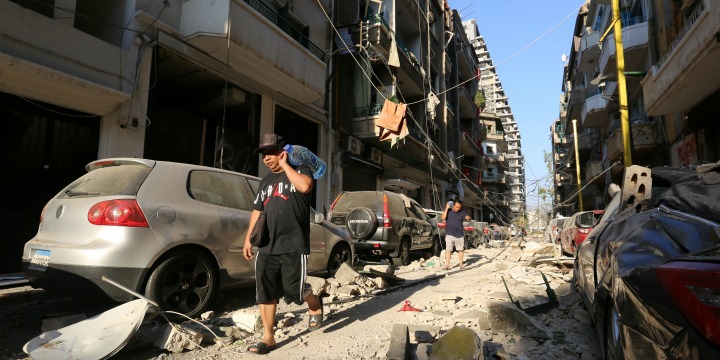
Men carrying bottles of water walk past damaged buildings and vehicles near the site of Tuesday’s blast in Beirut’s port area, Lebanon, Aug. 5, 2020. Photo: Reuters / Aziz Taher.
JNS.org – Even before all the details emerged about the enormous explosion that rocked Beirut on Tuesday, it was clear that this event would change things completely.
Because things in the Middle East don’t tend to blow up on their own, one’s first instinct is to look for the party responsible for the blast. WhatsApp groups and tweets rushed to finger Israel, but a quick probe prompted all political and defense officials in Israel to issue a flat denial.
Past experience also shows that Israel is very careful in selecting its targets, and even more careful in trying to ensure that its actions will not result in collateral damage — not only due to a desire not to kill innocent people, but also due to the understanding that an incident like this could launch a cycle of bloodshed and revenge that might even become a war. Errors can happen, but one of this magnitude — with thousands of wounded and vast damage — would be highly unusual for Israel.
In the first minutes that followed the event, some feared that Hezbollah would accuse Israel to avoid being blamed. But the organization, with help from news outlets in Lebanon, rushed to make it clear that Israel was not involved.
Things will become clearer once it is determined what exactly blew up in Beirut, and whether it was a military incident (involving a weapons storehouse) or a civilian one (stocks of some explosive material — rumors in Lebanon on Tuesday said that it was stores of nitrogen).
Either way, Israel and Hezbollah still haven’t settled their accounts. The organization wants to avenge the death of its operative two weeks ago in a strike on a weapons storehouse in Damascus that was attributed to Israel. The IDF is following all reports from Beirut closely, and for now, is not dropping the level of alert on the northern border.
But the Beirut blast could upend everything for Hezbollah.
It happened at a historic low point for Lebanon: The country is in the midst of an unprecedented economic crisis, with growing unemployment and on the verge of bankruptcy. Hezbollah is being blamed for thwarting economic reforms that were a condition for aid from the World Bank and European nations. Between that and the coronavirus pandemic, the Lebanese public has very little tolerance for any escalation of security tensions that Hezbollah might cause by attempts to kill IDF soldiers.
Now, after what might be the worst incident in Lebanon’s history, the public will have even less inclination for needless security headaches caused by Hezbollah’s foolishness. Given Israel’s clear warnings — originally reported in Israel Hayom — that any attack on Israelis would lead to strikes on Lebanese national infrastructure, we can expect growing pressure within Hezbollah’s ranks to avoid dangerous capers.
In addition to that pressure, an international tribunal is expected this weekend to publish its findings on the murder of former Lebanese Prime Minister Rafik Hariri. The prevailing belief is that the court will blame Hezbollah for the murder directly, and demand that it hand over the operatives who carried it out.
The organization will deny the accusations, but it’s doubtful whether 15 years after Hezbollah shocked Lebanon by murdering a popular prime minister, the group will now choose to destabilize the country again through a war with Israel. And to hamper Hezbollah even more, Israel on Tuesday was quick to offer humanitarian aid to Lebanon.
The gesture was made not only to show that Israel was not involved, but also to make it clear to Lebanon who are the good guys offering aid (Israel), and who are the bad guys who want to drag the nation into a war (Hezbollah).
Yoav Limor is a veteran Israeli journalist and columnist for Israel Hayom. A version of this article first appeared in Israel Hayom.