










The No. 1 Lesson of the Intifada: Initiate and Control
Error: Contact form not found.

 by Yoav Limor / JNS.org

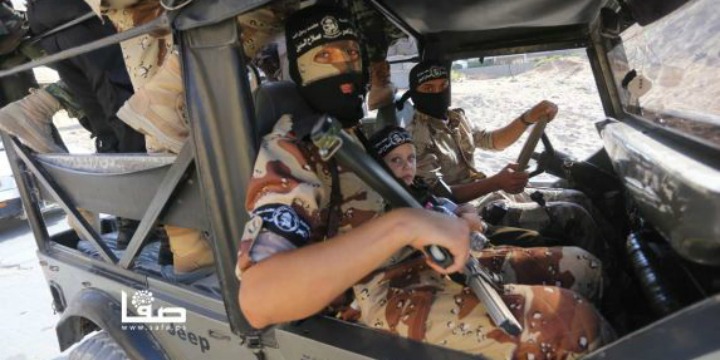
Palestinians, including children, celebrating the Second Intifada. Photo: Screenshot.
JNS.org – As strange as it might sound, Israeli society has repressed the memory of the Second Intifada. Despite the heavy price it exacted, there is no day of commemoration or memorial site for it, and it is rarely mentioned. Five or six years of terrorist bloodshed, which left deep scars on Israeli society and shaped its relations with the Palestinians for decades to come, have vanished as if they never existed.
The reasons are mostly psychological, obviously, but we should nevertheless address the lessons learned from the events that began 20 years ago after then-Prime Minister Ariel Sharon visited the Temple Mount. The date itself was random — PLO leader Yasser Arafat wanted a bloody battle, and if Sharon hadn’t gone to the Mount, Arafat would have found another excuse.
Arafat was looking for a “war of liberation.” He rejected the (generous) proposals made to him at Camp David and sought a state for his people that would be built on a foundation of fire and blood. He believed that a few days or weeks of fighting in which Israel sustained casualties would prompt it to make additional concessions. But there was one critical thing that Arafat failed to take into account: a few months earlier, Israel had withdrawn from the security zone in southern Lebanon. The Arab world saw that withdrawal as a panicked retreat. Hezbollah leader Hassan Nasrallah compared Israeli society to a spider web and used the eruption of violence in Judea and Samaria to kidnap three IDF soldiers on Mount Dov.
Israel could not, and did not want to, give in again and responded mercilessly to the Palestinian attacks. Every event ended in a resounding victory for the IDF. Instead of changing tactics, Arafat kept his back against the wall. He spurned every attempt to relaunch the peace process and raised the stakes of the violence. He started with shooting attacks, and even allowed members of Fatah’s Tanzim branch to take part in them, and then let the worst Hamas and Islamic Jihad terrorists out of Palestinian Authority (PA) prisons.
The flood of veteran terrorists into the field was felt immediately. The number of terrorist attacks, particularly suicide bombings, spiked, as did the number of Israelis wounded and killed. Ehud Barak lost the prime ministership to Ariel Sharon, who adopted a brave and cool-headed policy when he decided to let Israel rack up credit at home and abroad before giving the green light for an operation that would wipe out terrorist infrastructure in the West Bank.
There were two main events along the way to that operation. The first was the suicide bombing at the Dolphinarium nightclub in Tel Aviv in June 2001 (21 people killed), which caused the Bush administration to lose faith in Arafat and basically cut him off, and the second was the suicide bombing at the Park Hotel in Netanya on the eve of Passover in 2002 (30 people killed). After the seder night bombing, Israel launched Operation Defensive Shield. Along the way, the 9/11 attacks hit New York, and terrorism lost its legitimacy in the eyes of the world. Rather than understanding that, the Palestinians dug in. They are still paying the price for that.
When Israel retook control of Area A in the West Bank, security forces gained the freedom to operate throughout Judea and Samaria, but mostly, it restored Israel’s self-confidence. Since then, Israel has depended mainly on itself. This is particularly noticeable when compared to what is taking place in the Gaza Strip, where there are heavy restrictions on IDF activity, especially since the 2005 disengagement, which was also a belated response to the wave of terrorism that started in September 2000.
Still, Israel opted — and has opted ever since — not to cancel the Oslo Accords. Moreover, despite the lack of political contact with the PA, the two sides’ security apparatuses have been cooperating for 15 years, often intimately, saving the lives of many people on both sides. They even worked together against major challenges like an intifada consisting of “lone wolf” stabbing attacks. Palestinian Authority leader Mahmoud Abbas, who in the meantime has turned out not to be a peace partner, is leading Palestinians down a path different from that of his predecessor, one that opposes the Israeli “occupation” through mostly non-violent means.
It is unclear how long Israel will continue to enjoy quiet in Judea and Samaria (and Gaza). The Palestinian problem is here to stay. Israel has made a lot of progress since 2000, but the Palestinians are stuck far behind. They have lost on every front: diplomatic, security, economic, and social. If they aren’t given some prospect, at some point, they might rouse themselves and look for a violent way out.
So Israel would do well to implement the main lesson of the Second Intifada: take the initiative. Control events rather than being dragged into them; mark a target and go after it. Since the Second Intifada, Israeli society has proven that it is willing to pay the price needed for that to happen. It will do the same in the future if it needs to, and truth be told, in the present, if the leadership gives it a clear way to fight the battle against COVID.
Yoav Limor is a veteran Israeli journalist and columnist for Israel Hayom.
This article first appeared in Israel Hayom.


