




Report: COVID-19 Outbreak in Israel to Worsen Over Winter
Error: Contact form not found.

 by Israel Hayom / JNS.org

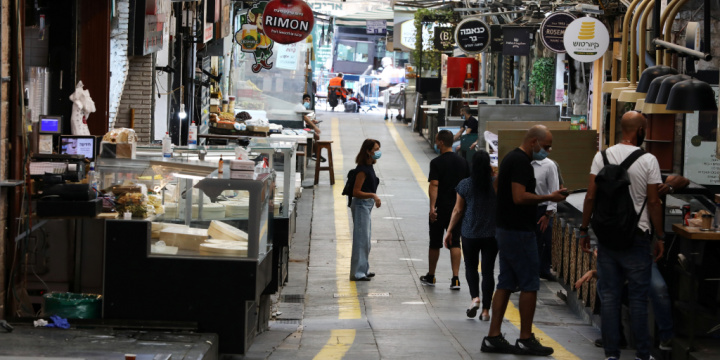
People wear protective face masks as they shop at a market, amid Israel’s second-wave coronavirus disease (COVID-19) lockdown, in Jerusalem, Oct. 5, 2020. Photo: Reuters / Ammar Awad.
JNS.org – A new report from the Coronavirus National Information and Knowledge Center finds that Israel is likely to see a spike in infections over the winter, when people will convene in small indoor spaces. The report makes particular note of schools, offices and public transportation as areas of concern.
According to the report, extended stays in unventilated spaces with multiple people engaging in such mundane activities as talking, particularly if they’re not wearing masks, will be much more dangerous during the winter months.
According to the authors of the report, schools, with their packed classrooms, are at serious risk, in spite of being equipped with air conditioners, which could actually aid in the spread of the virus. In any case, the recommendation in Israel has been to keep windows open while air conditioning is running.
In addition to the coronavirus, the report states, due to the advent of the seasonal flu, there is concern in the education system and among parents that children or teachers experiencing flu-like symptoms, such as coughing or a fever, could send an entire class, grade or school into quarantine until COVID-19 test results come back negative.
As for public transportation, the situation is also precarious, according to the report. Since the outbreak of the pandemic, thousands of people have reportedly traveled on buses and trains while infected, forcing thousands of passengers into quarantine. With some of the restrictions put in place during the second lockdown having been rolled back, public transportation in Israel is now once again operating on a normal schedule, albeit with a limit on the number of passengers. While this limit is enforced on trains, it is rarely enforced on buses.
Meanwhile, the report notes, offices are trying to meet the challenge through design plans and the adoption of guidelines for maintaining adequate employee hygiene and social-distancing.
Though the Coronavirus Cabinet was scheduled to meet Wednesday to discuss a further easing of restrictions, Health Ministry officials have said recently that there is no room to discuss the next stage of a reopening of the economy until the infection rate drops to 0.8 percent and an average of fewer than 500 new cases per day. By the end of Tuesday, the infection rate was 1.6 percent, and 663 new cases had been diagnosed.
According to Health Ministry data, as of Wednesday afternoon, there were 320,912 confirmed coronavirus cases in Israel, 8,167 of which were active; 307 patients in serious condition, with 135 on ventilators; and a death toll of 2,684 since the start of the pandemic.


